
The question of what consciousness is has long interested—and perplexed—philosophers. Plato’s dialogue in the Phaedo, for example, is (in part) an effort to work out what consciousness might be. But the quest for an understanding of consciousness intensified in the latter part of the 20th century, at least within English-language philosophy. Contemporary Philosophy of mind developed in order to make sense of consciousness, to explain how consciousness could be fitted into the materialist ontology which had, by that time, become unquestionably dominant within most of academic philosophy.
However, after many decades of earnest work, the effort to arrive at a decisive answer to the question of how consciousness might arise from the brain seems no closer to success today than it did in 1950; indeed, in many ways, the pendulum seems to have shifted. More and more philosophers seem dubious that any materialist explanation of consciousness will be forthcoming.1
Now, there is much to say about all of this, both in making sense of the materialist strategies in philosophy of mind (eliminativism, epiphenomenalism, and “constitutivism”) as well as in the premises, assumptions, and biases that informed those efforts, and the fact that non-materialist or semi-materialist efforts to develop a philosophy of mind have not necessarily been any more successful (at least, so far). Philosophy of mind is an extremely complex and confusing group of discourses. I intend to write about it plenty in this space, but I will have to make sure I only bite off as much as I can chew each week.
So today I want to offer a general remark about a fundamental confusion that I see in much of philosophy of mind discourse—materialist or otherwise. It’s a confusion that I think helps to explain why so much of the writing on this subject is so often so fruitless and opaque.
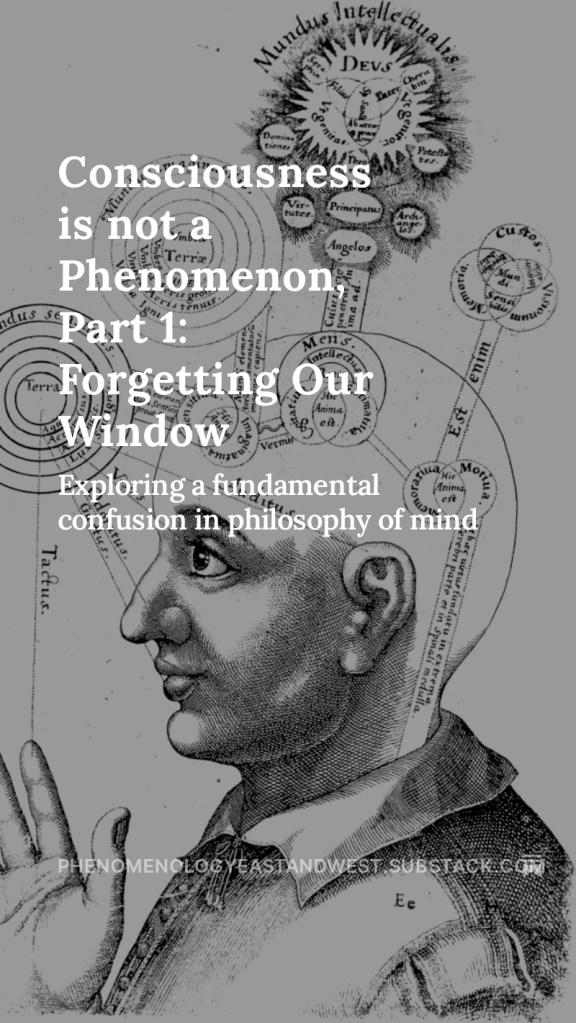
Continue reading at: https://open.substack.com/pub/phenomenologyeastandwest/p/consciousness-is-not-a-phenomenon
 Wrestling with the Angel