The Sky is (Not) Falling: On the Fears of a Shrinking Church


Source: Gallup; Credit: Matt Stiles/NPR

Over the past few years, one hears more and more about the crisis facing organized religion: fewer and fewer young people are coming to worship services, and the share of people who identify as non-religious seems to be growing and growing each year. Sociologists and religious leaders alike interpret this as evidence for the looming death of churches in the coming decades. The panic among ministers, priests, and bishops is palpable. More and more dioceses and parishes are rushing to appeal to the “nones“, to stem the tide, to keep their numbers up. Into this frenzied discussion enters the “spiritual but not religious”, which I wrote about a few days ago: people, by and large, are still seeking spiritual fulfillment, truth, etc. but aren’t interested in religious communities or institutions. Church leaders seem to think that the church must change or die; the writing’s on the wall.

I take issue with this whole line of thought on two broad fronts. The first is a demographic skepticism: I’m not so sure that the fact that 1/3 of young people identify as not religious is necessarily the Sword of Damocles over the head of organized religion. Note that this means, presumably, that 2/3 of young people do identify as religious. Considering that we have been hearing about the coming death of religion now for about 200 years, it doesn’t seem to me that we are facing the end of organized religion any time soon. It’s also not clear that this trend will just continue steadily into the future; note how the social and political trends of the 1920s–general social liberalism, a sort of muted libertinism, and a turn away from organized religion–essentially reversed for a few decades, beginning in the 1930s. Then in the ’60s, these trends came back with a vengeance, only to again face a good deal of reversal in the 1980s. Many of these trends may be more cyclical than linear.

And this demographic skepticism, as it were, is I think only reinforced by the data that suggests that what bothers young people about religion is not religion per se, but the political and social stances that they associate with religion. Robert Putnam of Harvard defends such a position in this NPR segment:

I think the single most important reason for the rise of the unknowns is that combination of the younger people moving to the left on social issues and the most visible religious leaders moving to the right on that same issue.”

But of course, there have been left-leaning Christians for centuries, and it’s simply not true that being religious necessarily means being conservative. In fact, the link between the two is probably very recent, the result of the party re-alignment of the 1960s, when Republicans, recognizing their policies were unpopular, sought to shore up support for their plutocratic economic policies by allying themselves with charismatic and opportunistic religious leaders, especially among Evangelicals. The irony is that the Evangelical movement was originally very progressive, for example many English Evangelicals were some of the earliest abolitionists, and the Pentecostal wing of Evangelicalism was largely a movement of working-class Christians who, for example, resisted Jim Crow and sought to build a racially diverse church.

And if the main problem for religion today, specifically Christianity, is its identification with reactionary politics, then the answer is relatively simple: stop supporting reactionary politics, which are, by my estimation, profoundly un-Christian anyway. In other words, the Church needs to pursue its real agenda, and not allow itself to be co-opted by the State or the ruling classes. Of course, this co-option has been going on since at least Constantine, but then again, resistance against this co-option, and protest movements and churches, have also been forming since that time, and one hopes that their counter-balancing effect can continue to keep the Church on at least something of an even keel. There’s good evidence, for example, that monasticism itself began as a sort of protest against the co-option of Christianity by political and social elites in the 4th century.

And this is where I really see the main threat of all this sky-is-falling public hand-wringing: so many church leaders think that, in order to survive, the Church basically needs to completely re-invent itself to meet the demands, essentially, of its consumers. In this view, the Church is a sort of business, and its losing market share. You actually see this sort of language in the discussion. But of course(?) the Church is not a business, and we don’t have consumers. Right? The danger of all this hysteria is that it seems we could really lose our way here. The threat to the Church is not that we might have fewer members in the coming decades, but that in the process of trying to appeal to a certain demographic of people–we would completely sell out on our real mission–to keep bodies in the pews, as they say. But our goal is not to simply have a lot of members, it’s to serve God, to follow the example of Christ, to act with loving-kindness to all people. If doing this results in many new members, as it seems to have in the earliest centuries, then excellent! And if not, then so be it our, our “business” is to try and perceive the Truth at the heart of reality and respond in obedience and love, not to be the most popular social club on the earth.

This, of course, does not mean we should ignore social trends. The Episcopal Church, of which I am a member, ordains both female and gay priests, something that I think it only did under extreme pressure, and perhaps even shaming, from secular voices. And I think this is a really good, wonderful thing. The Church certainly has a lot to learn from secular politics, philosophy, science, etc. We should not bury our heads in the sand or cut ourselves off from other communities. We’ve been wrong about a lot in the past and no doubt will be again. But just because secular society, taken as a whole, has been right about some things doesn’t mean it necessarily will be right about everything. I would certainly submit that though broad secular social pressure for women’s rights, gay rights, the rights of ethnic minorities, etc. have been absolutely correct, in other ways, the same sorts of social pressure are absolutely horrendous. Consumer capitalism, for example, is destroying communities, individuals’ mental health, and the environment, all in one fell swoop. Even a good deal of secular folks decry its materialism and de-humanizing shallowness. The Church was right to finally cede to pressure from the outside to ordain women and homosexuals; I think it would be dead wrong to accept pressure to continue accepting a more consumer-ized economic and social ethic.

In other words, secular society has provided a good sounding-board for the Church and has confronted it in many places were the Church desperately needed to be confronted. But the opposite may also–in fact, has also–been true. Let’s not forget that it was Christian leaders who spear-headed the abolitionist and women’s suffrage movements. In many ways, the complacent social and political stance of the churches throughout the 20th century was an aberration. The Church has often been a lone voice in defense of the oppressed, marginalized, and exploited in times past, where political and economic forces were rushing head-long to grind up vulnerable humans to serve the needs of the State and the Market. In recognizing the sins and hypocrisy of conservative Christianity, I think we are really finding our true, traditional voice in many ways.

This is not to deny that the Church was ever involved in oppression before the 20th century, of course. There were Christians calling for abolition, but there were also Christians trying to cite the Bible in defense of slavery. There were Christians advocating for women’s rights, but there were plenty obstructing the realization of those rights as well. Many priests and friars called upon the Spanish monarchy to end colonization of the Americas after seeing the horrors of the Conquista; but ultimately the Church obediently supported the Crown in its occupation of the New World and its brutal exploitation of native peoples there. I’m in no way arguing that the Church has always been on the right side of things, up until the 20th century. But I am saying it definitely has not always been on the wrong side of things. But the impression among many young folks, is, I think, that it has been. We simply need to stand up and confront conservative Christians and articulate a counter-narrative, one that is truer, both ethically and historically, than the one they are pushing.

And I think this is where we get to the real problem. Moderate, liberal, and progressive Christians don’t have a show comparable to the 700 Club, we don’t have dozens of talk-radio programs broadcast every day. We aren’t in the public eye; we’ve ceded the terrain so completely that in a mere 30 years, Christianity and conservatism have been completely conflated in the eyes of most Americans. This, I think, accounts for our demographic crisis. We’ve rather complacently sat around while the rug is pulled out from under us, and we wonder why people are uninterested in our community. The solution is not, I think, to try and appeal to a consumerized ersatz New Age spirituality, but actually the opposite: we need to embrace so much of our tradition that has been forfeited.

This can function in two critical ways: first, as we’ve discussed above, there is a legacy of counter-oppresive, pro-social-justice work in our community, from the very beginning. We need to make this explicit, we need to present a fuller account of our history. This should not mean ignoring or denying the evils and sins of our past, but simply also calling to people’s attention all of the good work the Church really has done, to show that our history, like all histories, is complex and variegated. Second, I think that what so many spiritual-but-not-religious people are seeking they will not find in the various ersatz spiritual movements and groups they are currently investigating. I could certainly be wrong, but I think people are hungry for something that is authentic and even traditional. I think they ultimately will want communities that welcome them with open arms yet also call them to accountability. They want to participate in something that can trace its existence back centuries, that ties them to their ancestors and to essential cultural foundations. For many in the West (by no means all), this means Christianity. But if we attempt to out modernize the the New Agers, we will lose everything that makes us unique and valuable: our traditions, our authenticity, and our heritage. We can accept the critiques of secular society without totally collapsing before them. We can admit the ways in which we have been oppressive, exploitative, and exclusive without abandoning our tradition altogether. And I think this is precisely what we must do.

Such a program would mean embracing both a left-leaning, even radical politics, while simultaneously re-asserting our liturgical, doctrinal, and devotional traditions. Such a program, at once leftist and liberal and traditional, may seem awkward, but in fact the Anglo-Catholic movement was, from the beginning, just such an intellectually diverse approach. I think it’s crucial that we not fall into the myopic trap of assuming that what has happened over the last 50 years is What’s Always Been. Let’s have the courage–and faith–to remain steadfast before God, accepting correction wherever it comes from, including from our secular fellow humans, but also standing firm on those issues where we know we have something valuable and crucial to the health of our society. The Church can be humble and confident, self-critical and self-assured. In fact, I think this is precisely what we must be. Let us remember the warning that our Lord issued:

No one can serve two masters, for either he will hate the one and love the other, or he will be devoted to the one and despise the other. You cannot serve God and money.

Let’s remember what our real priorities are. Even if the coming decades see a smaller church, we should keep our minds focused and our vision clear: our goal is to seek God and spread the Gospel, not to simply fill pews or build endowments.

Sam Harris, Science, and Morality

Sam Harris gave a TED talk in 2010 in which he argued that science can–and should–be used to define morality and ethics. His argument essentially boils down to this: moral decisions are decisions made about facts. The more we know about the world, the more facts we have about it and the better and more sophisticated our understanding of those facts, the better decisions we can make. Therefore, morality should be guided by science (and presumably not religion) because it is the scientific process that allows us to test which ethical decisions work well, and which are deficient.

At its core, I don’t disagree with this argument. For example, if we want to help children grown up healthily, I think it makes sense to research nutrition, to see what foods tend to help children grow quickly and healthily. Such an approach would be broadly scientific, and it’s hard to argue with. But it also seems clear to me that Sam Harris both misunderstands the traditional “science can’t define an ethics” argument and is overly credulous when it comes to science’s general merits. The presentation video is below:

First off, though Sam Harris seems to think that he is debunking the argument that science can’t provide the basis for ethics, he actually never discusses it. He is either woefully, even shockingly unaware of what the real debate is about, or is being disingenuous in his presentation. The claim that ethics and morality are beyond the realm of science is a claim about the foundations of ethics, not its application. It’s one thing to say that “assuming that X is good, science can help us achieve X”. I think this is a pretty uncontroversial statement. But what if someone questions the goodness of X? Sam Harris argues that science can help us to figure out how to help conscious beings live more fulfilling lives. But why is helping conscious beings live fulfilling lives good?

This may seem to be some sort of trick question, but it’s not. Harris simply assumes an ethical system, and then argues that science can help us to apply that system–and he’s right. But he completely ignores that science is essentially agnostic when it comes to the basis of ethics. Why is it wrong to kill a person? Science can help us develop better ways of saving lives, of fighting disease, perhaps even through psychology it can help us to deter people from attempting harm one another. But what does empiricism have to say about why it’s wrong to kill someone in the first place? The traditional approach has been to build on some sort of pragmatic or utilitarian philosophy, but again these simply assume the right- or wrongness of given activities, and argue how best to organize human activity so as to maximize the former and minimize the latter.

Science simply gives us data on causality and being: it helps us understand why and how A leads to B. But ethics is interested in whether A leading to B is good, bad, or neutral. And this is always subjective. Is my taking $100 dollars from your wallet a good or a bad thing? Obviously that depends on who’s asking. I may argue it’s a good thing; you would probably argue it’s a bad thing. Most observers would probably agree with you. But what if an extremely poor man stole $100 dollars from Jamie Dimon to feed his starving children? Dimon might actually argue that this is still a bad thing, but I imagine that most of us would not agree. Could science ever provide a definitive answer to this? It might very well provide better systems for preventing theft, it could also provide better thieving systems. But could it provide conclusive reasoning for deciding what actions are bad?

In short, why is it good to help conscious beings thrive? Viewing such thriving as a good thing is an act of valuing. I value conscious beings, but not for truly, or directly, rational reasons. I am delighted to see a dog playing, for example, but it’s not because I somehow think that the dog’s play will indirectly help me. It’s an emotional response, deeply complicated. Now, it is true that that science, in the form of psychology or neurology, could help explain why I find a dog’s playfulness enjoyable, and why I might choose to, for example, build a dog park, or rescue a dog from the pound. But is my choice to do so the right choice, from some sort of factual, objective standpoint? What does that question even mean? How would we determine the rightness or wrongness of my rescuing a dog, from a scientific standpoint?

The point of arguing that science cannot speak directly to ethical issues is to make it clear that science cannot give definitive answers as to why something is ethical or unethical. It can help us achieve a more ethical society (at least in theory) but science could be marshaled to defend any number of ethical systems which would conflict with one another. Science itself is ethically agnostic, because it objectifies the world. Science analyzes things into their components to understand them. Ethics is a subjective process in which unified wholes are valued for a complex set of reasons; different subjects value differing things, and there is no objective way to prove or disprove either valuation. Although science certainly can explain how the valuing occurs, it can’t comment on whether the valuing is good or bad, right or wrong.

Harris doesn’t seem to grasp this, which is amazing, because this is really fundamental philosophical stuff. He wouldn’t have to open the Bible or any other religious book to explore this conundrum; Sarte or Nietzche would do just as well. The disconnect between the world seen as an object and the world experienced as a subject is probably the oldest problem of philosophy, and one that still dominates it. That Harris could spend years writing about religion an ethics, and seemingly never come to understand this, is quite amazing and perplexing. But his position also belies a subtler, but still significant confusion.

Harris seems extremely confident that empiricism–science–will allow humans to build a better and better world; he seems to believe in the inevitability of human progress: as we learn more about the world, we can manipulate it into a better and better place for us to live. The evidence suggests, though, that science has had a much more equivocal impact on the world and on human life. Science has, on the one hand, brought us vaccines, and sanitation systems, and medical intervention, and increased food production, and all sorts of creature comforts. This can’t be denied, and let me be honest: I’m sitting in a heated room, typing on a computer. I have refrigerated food here, and all sorts of books, food, clothes, etc. that were shipped here on technologically advanced ships, trucks, and trains. I’m not a Luddite, and I’m not here to say that science is inherently evil.

But science has also brought atom bombs, machine guns, mustard gas, mercury poisoning, and global warming. It’s not some unalloyed good; progress isn’t guaranteed just because we are applying science to our problems. In fact, it could be argued that though science has improved the lives of a relatively small number of fortunate people, on balance it’s proving to be a growing catastrophe for life in general. This remains to be seen, though. Many people hope that we can use science applied through technology to address the problems caused in the past by science applied through technology. “Green” energy sources, for example, can hopefully be deployed to replace fossil fuels. I hope they are right, but I have to be honest that I’m not particularly confident. “Green” technology may prove to be extremely damaging to the environment; let’s remember that when people started burning coal on a large scale in the 19th century, they had no idea it would lead to the problems we now face. Manufacturing millions of solar panels and wind turbines will involve vast mining operations and the expenditure of huge amounts of energy, and their deployment into the environment may prove to have unforeseen negative consequences.

Of course, perhaps not. I’m not trying to define a wholesale anti-scientific pessimism, but I do think we should be aware of the limitations of our knowledge and the real possibility of serious problems arising from the solutions we are so enthusiastic about today. Ultimately, this credulous approach to science is very much an ideology; some have called it “scientism”. It boils down to a fervent confidence bordering on faith (though they would hate for me to use that word) that human beings, through the application of reason and empirical investigation, can fully understand the world, and apply that understanding through technology to master the world as on object. I am decidedly unconfident about our odds here; as we just discussed, our history suggests that science’s advances nearly always come with huge downsides, major vulnerabilities. I don’t think we are as in-control as “scientismists”, as it were, would have us believe.

And, interestingly enough, this gets us back to the subject-object dichotomy discussed above. A highly credulous view of science ultimately depends on a fully object-focused view of the world that is reductionist and even mechanical. Such a view is less and less capable of making effective predictions as more and more complex systems are added to what is being observed. We are coming to find that the earth, as a biosphere, is far more complex, and sophisticatedly balanced, than we realized before. The argument that we can simply apply our ever-increasingly knowledge to the objects before us and increasingly develop a more convenient environment runs into the real experience of humans, that as we manipulate the biosphere to garner given benefits, real costs are extracted, though often in hard-to-predict ways, and often on people who were not involved in the development of the original technology (i.e. these effects are often “externalities”).

Harris, then, misses the mark, I think, both in his basic philosophical confusion, and in his over-enthusiasm for science as a sort of panacea for all human ills. Again, none of this is to say that I do not believe we should apply science to our problems. But, first, I think we have to recognize the science itself is built on a wide base of philosophical assumptions, some of which may prove to be false, and that there are questions that this system of though cannot effectively answer in full. Ethics is perhaps the best example of this; science can certainly  help us to apply our ethical system, but it can’t answer the basic, fundamental, crucial questions at the very core of our ethical investigations. Second, science itself is a bit of a fickle mistress: what it gives with the right hand it takes with the left, and I think we need to be much more cautious with it than many modern science-boosters would have us be. Harris seems to make massive errors in both of these areas of thought, and I am sad to see his public influence continue. It’s especially ironic that he fancies himself a trusted ethicist, considering that he apparently believes that “some propositions are so dangerous that it may even be ethical to kill people for believing them” (The End of Faith, p. 52). Harris really seems to be the epitome of polarized, hyper-empirical “scientismist”: fully confident of his own moral rightness and his capacity to understand anything and everything. He is much more similar to the oppressive religious leaders he is so (rightly) critical of than he seems to realize.

I would submit that the video below, an abbreviated (and wonderfully animated) recording of a presentation that Iain McGilchrist gave to the Royal Society for the encouragement of Arts, Manufactures and Commerce, portrays a much more accurate, useful, and sophisticated view of human decision-making than Harris’.

[UPDATE: this post appears in slightly modified form at the Tikkun Daily Blog]

On the Importance of Being Spiritual AND Religious

[UPDATE: This post has been re-published in slightly-modified form at the Tikkun Daily Blog.] At the beginning of this past semester, I was invited to read Diana Butler Bass’s Christianity After Religion. I attend a small seminary, and it seems that this book was suggested as a way to encourage the vast majority of students who are clergy-in-training to confront the reality that religious institutions have lost both influence and respectability over the last 5 decades, to say nothing of the 2 centuries before that. The world has changed; and as they say: change or die. Bass–and by extension, my seminary, or at least whoever is in charge of suggesting preliminary reading material [UPDATE: a faculty member has informed me that the person who selected this book actually did not agree with much of what it contains. The discussion we had during orientation did not touch on any such disagreement, however, which led to my confusion on this. Of course it’s great to read things one disagrees with, but it’s also good to point out problems and errors in assigned reading!]–seems to have a very clear idea of what the Church must do to remain relevant to modern people, and she lays down the challenge, as she sees it, and her proposals for meeting that challenge. Simply put, I was unimpressed. To be both more honest and less generous, I was amazed and appalled by the shallowness of her analysis and the obvious pandering of her proposed solutions. Let me get to some details.

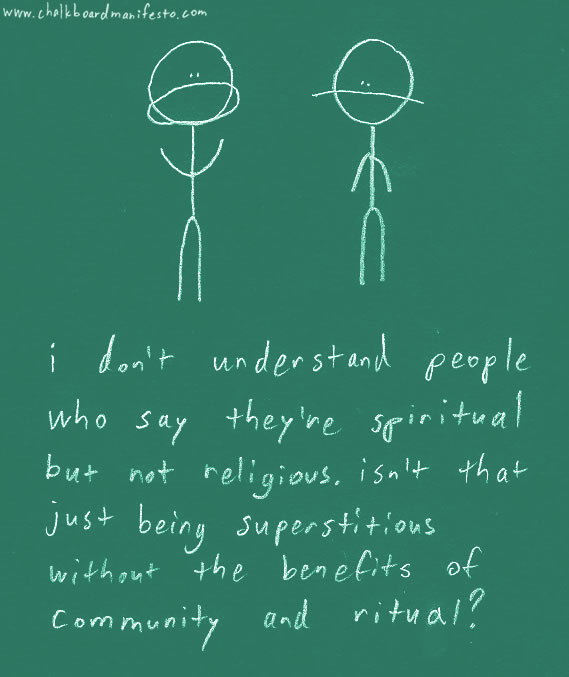
Bass is, essentially, a supporter of the “Spiritual but not Religious” line of thought. In short, proponents of this attitude want to pursue a personal spiritual “quest” but are uninterested in religious institutions, rules, or communities. This is a simplistic description, but this is part of the problem: the spiritual-but-not-religious attitude is itself a gross oversimplification, as if spirituality and religiosity were two distinct modes of action or being that one could pursue independently of each other and a whole host of other cultural, social, and political practices. It seems to be a reaction against a traditionalist, conservative, rule-obsessed 19th century Protestantism. But is a rejection of this specific type of religiosity a rejection of “religion” altogether? It seems to me that only someone who had barely reflected on the issues at hand could actually answer yes to this question. Bass spends considerable time in her book exploring what these words “spiritual” and “religious” mean to various people (pp. 68-71), and ultimately ends up admitting that the two words have such varied and diverse connotations that distinguishing between them is hard. In fact, in chapter three, she admits that post people want to be both spiritual and religious (p. 93). Nonetheless, throughout the rest of the book, she continues to operate with a hyper-simplistic and uncritical attitude that the two are diametrically opposed.

Part of the problem with Bass’s approach is the confusion between description and prescription. Is she simply telling us truths about the reality of the world? Or is she exhorting us to change our ways? Of course, the one could very well lead to the other, but the relationship between them shouldn’t be taken for granted. Take, for example, pollution. One might describe the reality that our world is increasingly polluted, and thereby recommend or prescribe moving to an unsullied mountain range, buying a hazmat suit, or investing in pharmaceutical companies making anti-cancer drugs. This is all perfectly logical, but there is a wholly different sort of response: maybe we should try to stop polluting the place we live in. So when Bass basically describes a modern world filled with people only interested in convenient, overly-optimistic, individualistic ersatz “spirituality”, is she simply telling church leaders how things are? Or is she recommending that we join the bandwagon? Personally, I would agree that this process is occurring, but I don’t think it’s a good thing, and I would call on the Church not to simply concede that people are no longer interested in what we do and therefore that we should completely change our mission. I would call on the church to be critical of something if it seems bad.

Of course, I’m not suggesting an inflexible traditionalism. We absolutely must be willing and able to respond to modernism. But that doesn’t mean giving in completely to it; modernism has both good and bad aspects. Let’s humbly accept the former while calling the latter what they are and resisting them. I support women’s ordination, the ordination of homosexuals, Christian engagement with environmentalism, theological engagement with modern philosophy, dialogue with our atheist and secular fellow citizens, and a full recognition of the separation of the church and state. These are all certainly modern developments, and I’m glad that the Church has been forced–and it was forced–to accept these critiques.

But modernism has also brought all sorts of bad things, and I want to be able to point those out, and hope that the Church will resist them. Science has brought all sorts of realy great things, but it’s also brought pollution, atomic weapons, and global warming. Modern society is much more tolerant than societies past, but it is also often extremely lonely and alienating. Capitalism has brought lots of choice at the cash register, but it’s also brought incredible exploitation and suffering for working-people. So let’s, by all means, accept the modern developments that seem good to us–and let’s fight the good fight against all the evils modernism has also brought. There’s no inconsistency here; plenty of things have good and bad aspects. And building a better world means discerning between the two.

So, when it comes to the spiritual-but-not-religious (this is getting arduous to write, from now on I’ll acronym-ize this SBNR), what does this mean? Well, Bass herself links the increasing desire for ‘spirituality’ with the development of consumer capitalism (eg. 41-43). It seems clear to me that the SBNR is the religio-spiritual manifestation of late consumer capitalism. It’s totally individualistic, and sees the Church/religious institutions as essentially businesses. Bass seems to be pointing out that these businesses are providing a ‘product’ that fewer and fewer consumers want–so why not change the product offered? That’s certainly the logic of the market. If Kellogg’s noticed that a cereal wasn’t selling well, it would be discontinued or changed, because that’s how the company can make more money and keep its shareholders happy.

But isn’t this sort of mercenary decision-making precisely the sort of thing that SBNR people would find offensive? The irony is that late consumer capitalism has so impoverished our sense of real community and the presence of Spirit that we are searching for individualized, customized, comfortable, convenient “spirituality”, even though it’s the very pursuit of this sort of thing that has impoverished us in the first place! Spiritual transformation is not a matter of finding an easy fit, a fun new practice, or following a trend. “Take up your cross and follow me” is not the sort of tagline you can put on a new yoga exercise or some new meditation technique (I am by no means dismissing yoga or mediation, which are ancient spiritual practices, but rather the insipid versions of these peddled by all-too-many Western entrepreneurs). It is a radical call to abandon every false sense of security, every false confidence we have, and trust radically in the mystery of God. Christianity, taken seriously, is intensely radical. I find SBNR so frustrating and aggravating precisely because it is hopelessly boring, so incredibly mainstream: it’s precisely what capitalism does to religion and spirituality. Lenin supposedly once said that capitalists would sell him the rope he’d use to hang them. Modern westerners will try to buy the very spirituality they so desperately search for because they have become totally consumer-ized. It’d be funny if it weren’t so damned sad.

Now, none of this means that Bass is wrong descriptively: she’s absolutely right to point out that this trend is happening and she is absolutely right that the Church must respond to it. But I would argue that we need to do exactly the opposite of what she proposes. I think that these various trends and fads–this hyper-individualistic, consumable ersatz spirituality–will flash and burn out like many trends before it. What people are really looking for (and I say this as someone who spent years looking myself!) is an authentic, enriching, challenging spiritual community. I’ve chosen each of those adjectives quite intentionally. The problem with SBNR is that it is none of them. It’s not the least bit authentic; SBNR practices tend to smack of a cobbled-together New Ageism. It’s not enriching, because it seeks to give a sort of shortcut for spiritual fulfillment, which is a complete contradiction in terms. And it’s not challenging because it simply reinforces our own narcissistic and self-congratulatory reflexes. It’s true that we often need to be kinder to others and even ourselves. But it’s also sometimes true that we need to be called out, be held accountable. The road to Hell, they say, is paved with good intentions. SBNR is full of good intentions–but little else.

Finally, SBNR is in no way a community–it explicitly rejects community when it rejects religion. In seeking a spirituality that is personalized, individualized, and reassuring, we necessarily exclude a community. Of course, one of the problems with any community is that people–most of all other people, as Oscar Wilde pointed out–are so often boring, arrogant, needy, and upsetting. The trick, of course, is to realize that you are Other People to other people, and those same traits doubtlessly describe you. A religious community can keep us accountable, and it can keep us humble, and it can save us from the Great Adversary–our own high opinion of ourselves.

Of course, this doesn’t mean we should accept the discipline of a community uncritically–and of course, many religious communities have been unduly, even unjustly harsh, intolerant, and oppressive to lots of people in the past. But SBNR is no magic bullet; it simply trades one danger for another–and it’s all the worse because it reflects all that is worst about late consumer capitalism. I am not suggesting that we be Religious but not Spiritual–I’m asserting what past generations, I think, took for granted: if one wants to be spiritual, one must be religious–and vice versa. They don’t work apart from each other. Spirituality without religion is a convenient, comfortable, self-congratulatory illusion; religion without spirituality is stale, dogmatic, and dead. Bass and other SBNR proponents have, I think, been so fully immersed in the logic of capitalism and modern individualism that they cannot understand any other way of looking at the world–even though this modern viewpoint is diametrically opposed to the very spiritual enrichment they so desperately seek.

The main takeaway of all of this, for me, is that much of what Protestantism discarded with in the 16th century–the sacramental, sacred, engaged, community-focused rites of medieval Catholicism–is precisely what modern Christians are yearning for without knowing it. Again, let’s not oversimplify: the Reformation was right to challenge the ecclesial abuses and warped theology of indulgences of the time. But I think in many ways, the baby was thrown out with the bathwater. Protestant Christianity became a wholly intellectual, private affair, a sort of legal transaction between God and an individual human being–instead of the loving, mysterious embrace of creation by Creator. But the solution is not some sentimental, anti-intellectual New Age nonsense. It’s a restoration of a balance between reason and emotion, devotion and theology, sacrament and study. For Christians, I think this begins by endeavoring to explore deeply what the Real Presence of the Eucharist means. This does not have to translate into acceptance of the doctrine of transubstantiation (it certainly doesn’t for me) but it means rediscovering the spiritual riches of our religious practice. The alternatives are a dead religiosity or a superficial ersatz spirituality. May the Holy Spirit guard us from both.