The Threat of Power and the Limits of Solidarity

protestkyates“Power concedes nothing without a struggle. It never did and it never will.” Frederick Douglass sums up the fundamental attitude that has animated the American radical left and labor movements for the last 150 years. To place one’s hopes in electoral politics, business reform, or the goodwill of elites, from this perspective, is to believe the fairytales of Liberalism. Far from being a series of reasonable conversations by reasonable people, labor organizers and radical leftists have a much more Realpolitik conception of politics: it is a struggle of power. If workers, minorities, women, the LGBTQ community, etc. want change, they have to identify, expand, and mobilize real power to force those in positions of authority to either cede to their demands, or be removed from office.

In short, whether explicitly or not, leftism recognizes the truth of Marx’s claim that human social relations were largely (if not entirely) reducible to class struggle: political and economic structures are simply means of extracting value from workers while returning to them less value (in food, clothing, etc.) than they generate. The margin between the two, between revenue and expenses, is profit, itself the essential fuel for the engine of reinvestment, by which capital reproduces itself.

Fundamentally, this view of human society results in radicals’ taking an adversarial stance to all of those in power, whether government administration, in business, or indeed in mainstream culture. All such figures are understood via their structural, rather than individual, identities: their incentives are to maintain the system that gives them power, wealth, and prestige, and so no matter how morally upstanding they may be as individual people, they will, push come to shove, always serve the interests of capital, even if that means horrendous devastation for workers, the environment, racial or sexual minorities, etc. It is the structure of power, and not the personal qualities of the various officers, representatives, or managers, that is essential.

Now, one could certainly, even from a radical-leftist perspective, challenge this account. I’ve attempted to compress nearly two centuries of political theory and practice into three paragraphs, so inevitably I have engaged in massive generalizations. But for the moment I want to assume this basic framework of political thought to raise a question about specific political practices (a debate about how accurate the above account actually is would itself, of course, be valuable–but I won’t be addressing that in this space.)

In short, assuming the above account, how does one avoid falling into a kind political nihilism? If it’s the case that everyone, without exception, is only serving their particular role in reproducing capital as an abstracted value controlled by a small class of property-owners, then how can workingpeople ever generate real communities of resistance? Won’t it be the case that even fellow workers will themselves always be waiting to take their own cut of capital’s spoils? If all are corrupted by the structure of capital’s mode of self-reproduction, on what foundation can real movements of justice and liberation be built?

Well, the committed leftist can respond, according to the theory of class struggle itself, those who do not find themselves directly benefiting from the generated profit of capital’s reproduction–e.g., the workers whose labor is exploited, from whom this value is ripped–have a unique structural role within capitalism. From this (more or less orthodox Marxist) viewpoint, the goal is to clarify the confusion of false consciousness, to make it clear to all workingpeople who their real enemies are, and thereby build solidarity among such people–who, after all, generally constitute a majority or near-majority of most populations in industrialized nations.

From this perspective, then, power is built in a perhaps cynical, but at least honest way: workers should be willing to commit to radical leftist politics for their own individual interest, even if lofty concepts like justice and equality in the abstract don’t motivate them. The problem with this perspective has become particularly clear through experience of organizing in the US during the 20th century. So long as workers view the political landscape this way, and sign on to radical politics only so as to get theirs, they will constantly have an incentive to abandon the movement if capital offers them a better deal. Indeed, this is what has happened time and again, perhaps most obviously in the case of the AFL, which as a craft/trade union of skilled workers, has often (especially in the early 20th century, before joining with the more militant CIO) had incentives to abandon industrial workers and other low-skill workers in their contracts. This historical fact reveals that in many ways, many workers themselves are basically potential petit bourgeoisie, or to put it more plainly (and to quote* John Steinbeck): “I guess the trouble was that we didn’t have any self-admitted proletarians. Everyone was a temporarily embarrassed capitalist.”

This tendency of workingpeople to break ranks and make separate deals is a serious problem, and, unsurprisingly since this is not my area of study, I have no helpful or pragmatic response to it to offer here. But it also brings a related problem into sharp relief:

In many ways, the basic theory of class struggle hurriedly outlined above has only been made even starker by critical theory and Michel Foucault‘s work, which (to massively generalize and paraphrase), stresses that all human communication is fundamentally oriented to the maintenance and expansion of power, even–perhaps especially–if the person communicating doesn’t realize this (it’s not always their power that is being maintained or expanded, of course, e.g. internalized racism). This view simultaneously brings important, if depressing, facts about human social life to the surface, but also runs the risk of destroying the potential for building solidarity among workingpeople, for if everyone, no matter how marginalized, is simply a node of power reproducing itself, if we are all in truth temporarily embarrassed millionaires, if all of our interactions are really just sly flanking maneuverings in socio-economic combat, isn’t all hope for a liberatory politics lost?

This is not a purely theoretical question, as many of the political movements among Millenials have focused on precisely this problem, albiet often somewhat implicitly. I offer two examples: first, I would point you to the claim made by some black feminists and womanists that “solidarity is for white women“, a phrase that spread as a Twitter hashtag in 2013 and which simultaneously exposes the real fault lines of leftist and progressive movements as well as the cynicism which lies just beneath the surface of a political discourse that so often tries to build itself on a foundation of hope. Likewise, the honesty of many black organizers in the Movement for Black Lives has led to many of them directing sharp criticisms both at politicians one expect them to see as likely allies–e.g. both Bernie Sanders and Hillary Clinton–but also at white allies more generally.

Many (white!) commentators immediately dismiss such critiques, calling for maturity, pragmatism, or (insert other code-word for “please shut up” here) among such activists and organizers: even if they have serious critiques of white allies, the thinking goes, they should keep quiet for fear of giving ammunition to the real enemy (Republicans, et al.) But this tone-deaf response fundamentally misunderstands what these black critics are pointing to: that even among well-meaning whites, decisions are still being made according to a power calculus, and these activists are refusing to settle for any less than their fair share of power. They are being honest that it is this that they want: power, and nothing less. Real power. Decision-making power. They don’t simply want to place some well-meaning white in authority and trust that she or he will do the right thing. They don’t trust us (and why should they!?) Instead, they are saying: give us the power, and we will make the decision. Nothing less will do.

In its own way, this is a return to the stark but deeply insightful political analysis of the 60’s Black Power movement, a turn away from the emphasis on electoral politics and slow reform and progress that defined the civil rights movement from the 70’s through the early 00’s. Trust was given and was broken, not only by white politicians, but also by many black ones, who prioritized maintaining and expanding their own personal power over doing what was actually best for their constituents. And, of course, this is precisely the sort of behavior that Marxist and (in its own way) critical theory/Foucauldian analysis would predict. Everyone’s actions are, in some way or another, movements to maintain or expand power. To get what you want, you have to maintain and expand your own power. In that sense, BLM and critiques of white feminism are both products of serious reflections on the reality of politics.

But this brings us back to our original question: what can we expect the result of this realpolitik to actually be? Does this honest assessment of power have the potential to generate a truly liberatory politics? Or is it actually just the opposite, the codification of exploitative power? For if the above account is correct, then no one–not even the current leaders of the BLM–can ultimately be trusted. To the extent that they succeed and gain real power for themselves, they can be expected to act to maintain and expand that power itself, rather than necessarily wield it responsibly in the struggle for justice. This, of course, is not some particular critique of these individuals, but simply applying to them the very lessons they have learned from their own lives and the history of their communities, as catalogued above.

At this point, dear reader, you probably see the double-bind: recognition of the reality of how power operates simultaneously gives and takes away. It gives marginalized people the knowledge they need to see their own political, economic, and social conditions more clearly (i.e. dispels “false consciousness”) and to work to develop power with other marginalized people to overturn the structures that are crushing them. On the other hand, and by the very same token, it also predicts what will happen if they succeed: the same cynical use of power by whoever manages to lead such organizations of liberation.

I hope I have accurately diagnosed the problem, even if only in a very generalized and truncated way. But as for solutions to the problem, well…it’s at this point that my mind moves to further philosophical and theological speculation, precisely because I think what the above suggests is that politics is itself the very problem that liberatory political activity seeks to solve. But as Audre Lorde made clear: “the master’s tools will never dismantle the master’s house.” Applying this insight to political economy, having dis-covered the fact that our very lives and identities are both causes and effects of the way in which power is reproduced according to the structures of capital, can we expect that wielding power itself, if it is wielded in precisely the way that the owners of the means of production wield it, can lead to real liberation? I hope to have made clear in the above that I am not optimistic about such a program, no matter how “democratic” it seeks to be.

But, then what? Am I just contributing to the very cynicism I earlier seemed so wary of? I can’t really deny the claim, and as I said above, I have no concrete answer or solution to offer. But I can offer a more general, theoretical point: what is needed is a transformation of the way we think about ourselves, about power, and about each other. We need to exist in such a way that we see ourselves and each other differently, and–by the very definition of what I am saying–I can’t imagine what this other way of seeing self and other will be, because, of course, if I could imagine it, I would know it! I would already be occupying that epistemic perspective. I can’t imagine what it would be to not see myself a power-managing being wrestling with other power-managing beings.

Now, I am not suggesting that simply by thinking of ourselves differently, we can magically transform our material circumstances or social relations; rather I am saying that a condition of possibility for such a real transformation of the material and social is a new way of thinking. In short, we have to be able to imagine a different mode of relations in order to challenge the current one. But if it is true that our imaginations are themselves limited by the very social relations in which we currently find ourselves, then the double-bind explored above comes back with a vengeance. I have to imagine the possibility of a new set of social relations, which I can only do once I am already existentially defined by those very (as of yet non-existent) social relations(!)

At this point, Marxist theories of the Proletariat as the Subject of History, or the deeper Abrahamic narratives of the eschaton upon which the former is based, loom in my mind. But these, of course, have their own well-rehearsed limitations and failures. I want to end here, honestly, having charted the terrain and perhaps made a simplistic map. That I can’t see beyond the horizon of my own social location to new possibilities of a transformed power, a power that can be more than zero-sum, doesn’t mean that someone else necessarily won’t be able to. May my map, however poorly drawn, be of some help.

On the Duplicity of Clinton’s Anti-Racism

hillary-clinton-bring-it-on-mic-getty-640x480In many ways political campaigns are like pop songs–they need a hook, a central point, image, or mood that animates them and drives them forward. For Obama it was the image (if, ultimately, not the substance) of Hope and Change at at time when the economy was collapsing and America’s image abroad was thoroughly tarnished. For the Republicans in ’94, it was the “Contract with America“; Reagan struck a similar tone in 1984: “Morning in America“–both this and Gingrich’s Contract were meant to invoke a return to past stability and prosperity.
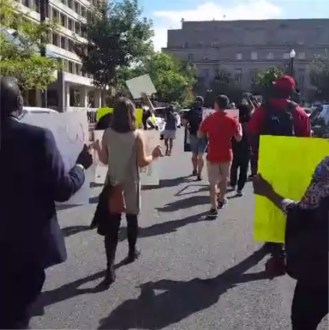
What do we have this time around? Interestingly enough, for the Clinton campaign, race has played a major role. In some ways, this is not surprising: her husband was famously the “first black president” and both Clintons have long polled well with with African-Americans (and at times other ethnic minorities). Furthermore, the GOP nominee is especially abrasive when it comes to race, even for a Republican: Donald Trump has made xenophobia against Mexican- and Central-Americans, as well as friction, to say the least, with black protesters, central to his campaign. With such an opponent, it makes sense that Clinton would try to play on the anxieties of people of color to boost electoral chances.

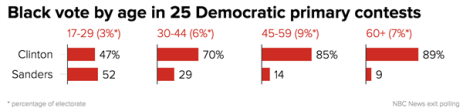
But the story of Clinton’s race-strategy isn’t as simple as this. Her campaign and its many proponents did not begin to portray her as the anti-racist candidate only after the primaries were over. Race featured as a major issue in the Democratic primaries, with the campaign itself and many in the media suggesting that much of the support for Bernie Sanders was itself animated by white anxiety or even outright racism. Unlike with Trump, this accusation lacked any real basis apart from some irresponsible fidgeting with polling data.

black-vote-dems_cc84abd808e194d21d16a8c49cd504af-nbcnews-ux-600-480

For one, Sanders had many people of color endorse him. Secondly, he did as well or better with young people of color as did Clinton; it was only older POC who supported Clinton by large margins. Third, and most substantively, Clinton is on record for supporting a range of policies and laws that disproportionately harm POC–the omnibus ’94 crime bill and the welfare “reform” act of ’96 being the most infamous.

All of this considered, it’s not obvious that Clinton should necessarily receive the mantle as the champion of minority causes. And yet she has positioned herself as just that, and, by and large, most of the major media outlets have not questioned her on this (though some smaller outlets have). Now, explaining this phenomenon en toto could fill volumes of books, and ultimately would require an expertise I lack. There are a host of questions around political messaging, grassroots leadership, demographic trends, etc. that would have to be asked and answered to really get at the heart of this seeming paradox. Nonetheless, there is one dimension of this situation that I think especially needs to be discussed both because of its immediate relevance and its structural impact.

In short, Clinton’s successful posturing as the POC champion is linked to the way that journalists tend to talk about racism in this country: racism is the result of the ignorance of poor white people (it should here be noted that poor white people are actually more likely to vote for Clinton in any event–a fact which only underscores the deceptiveness of this whole narrative). You see this narrative everywhere, and its has deep roots. It’s apparent in Harper Lee’s classic To Kill a Mockingbird. It’s clear in the coverage of Donald Trump’s support. It’s always in the background, framing the way we talk about race. Indeed, “racism” and “ignorance” almost always come as a package deal whenever the issue comes up in American discourse on these topics.

Now, undoubtedly, ignorance plays a central role in racist attitudes. But it does not play an exclusive one, and it’s all the things that are left out of this common analysis of racism that I think we need to talk about more.

First and foremost, racism-as-ignorance presents racism as a sort of massive and unfortunate accident, as if white supremacy just happened due to the lack of good schooling in the early colonies. And this presentation is intentional, because it fundamentally lets well-educated (and wealthy) whites off the hook. The actual fact of the matter–that white supremacy was and is a culture and ideology explicitly designed by wealthy and well-educated whites to justify slavery and the theft of land from Native Americans–is obscured by linking racism and ignorance in a linear and one-to-one fashion.

Another way of making this point is to say this: racism was developed, and encouraged, and it thrived, and became hegemonic, because it was profitable. The political-economic circumstances of North America were rather unique: a massive amount of arable land was available (though by no means uninhabited) for exploitation, but there was insufficient labor to grow cash crops (like cotton and tobacco). So a) the indigenous people needed to be either transformed into cheap laborers or removed and b) massive amounts of labor needed to be relocated to the colonies. Early efforts by European governments and land-owners generally employed actual purchases to achieve the first goal, and indentured servitude to achieve the second. But neither of these worked quickly, cheaply, or completely enough. White supremacy was the stone that killed both birds. It justified ever-more rapid and violent displacement of Native Americans as well as the permanent enslavement of black Africans as chattel–itself an innovation in the laws and concepts of enslavement.

All of this is to say that racism was generated not by ignorance, but by a savvy–but also demonic–understanding of how agriculture functioned as a business. Natives Americans and Africans alike were nothing more than resources to moved, employed, and destroyed, depending on the wishes of property-owners.

White supremacy, of course, also had another vital function: it provided the necessary wedge to keep working-class and peasant whites from organizing with Native Americans or Africans. And this wedge was not only of theoretical value, since the 17th century witnessed a number of uprisings in which people of all three groups united to attack landowners. In regards to the poor white population, white supremacy functions in the classic divide-and-conquer strategy: under this culture and ideology, even the poorest, least-respected white has a dignity not afforded to any non-white. Such a white person perceives himself as having a place, a status, in the system–and something to lose if it were challenged–and therefore will act to uphold it, even if doing so is inimical to his own long-term material interests.

This latter point does bring us back to the issue of ignorance: how poor white people were and still are tricked into supporting policies that are not helpful to them through the ideology of white supremacy. But to treat this situation as simple “ignorance” is to ignore what’s actually going on. To lay the blame for white supremacy on the ignorance of poor whites is to act as if these people could and should know better, but due to their own sloth or inattention, simply haven’t figured the truth out. In fact–and of course–these people are actively deceived, have been and are continually barraged by propaganda, explicit and implicit, to keep them ignorant. You might as well tie a handkerchief around someone’s eyes and blame them for being blind.

That’s not to say that those poor whites who accept racist arguments bear no  responsibility for their own beliefs, expression, and actions. But to lay the blame completely and exclusively on them simpliciter is deceptive in the extreme. And this brings us back to the concrete axis of this discussion: the Clintons have been more than happy to benefit from white supremacy when they could; they only posture against it when they think it will be to their advantage. Let’s not forget Bill’s (and Hillary’s) statements about “super-predators” in ’94, or the eagerness with which he executed Ricky Ray Rector in ’92. Likewise, let’s not overlook Hillary’s own eagerness to bomb POC in Libya, in Yemen, in Pakistan, in Palestine–as well as her own vocal support for the above-mentioned actions of her husband when he was in office.

If the Clintons’ opponents are overtly racist (as right now), they tack to the left, adopting the language of the civil rights movement and layering themselves with a thin veneer of concern. But if their opponents already sit to the left of them on such issues, they instead engage in dog-whistle politics, scaring middle-class whites into support of their centrist triangulation.

Now, supporters of Clinton’s are likely to counter at this point–well, actually, much earlier than this point–that none of this is relevant since Clinton is clearly preferable to Trump on any number of issues, race especially. And this is the frustrating wall that one always hits when criticizing the Democrats from the left: one’s opponents will argue with you until you actually bring up your evidence, at which point they switch to the with-us-or-against-us rhetorical tactics, suggesting that any criticism of Clinton is necessarily support for Trump.

But this is just pure nonsense. One might as well suggest (insert pithy remark on Godwin’s Law here) that to criticize Winston Churchill’s chauvinistic attitude towards the British Empire and his conservative values in domestic policy is somehow tantamount to supporting Hitler, because those two found themselves in conflict during World War II. But in truth, I can have criticisms of both without that criticism, in any way, shape, or form, implying any support for their rival. Of course it will be the case that my criticisms of Hitler are much more severe and firmly held than my criticisms of Churchill, but that doesn’t mean for a moment that I should refuse to criticize the latter.

And this is what is so frustrating about such discussions with Clinton-supporters. They see facts, if those facts reflect poorly on Clinton, as pro-Trump, and therefore inadmissible, despite their status as, well…factual.

Of course, as a leftist, my critique of Clinton is not meant to hurt her chances in this general election–I earnestly, if un-enthusiastically, hope she wins. Rather, the goal of such critiques from the left is to indict the whole set of assumptions which undergird the contemporary American political mainstream. When Clinton is the “leftist” option, we should know we are in trouble, and however much it might make sense for us to support Clinton in the short-term, we also need to be building consciousness to effect change in the long-term that pulls the Overton Window to the left.

Some Clinton-supporters may fundamentally agree, but then argue that we should reserve such conversations to non-election years so as to not damage the Democrats’ chances at election. The problem, of course, is that, first off, many Americans only really engage in political discourse in the months leading up to elections, and, secondly, in the off-years, the parties are focused on fund-raising and backroom deals. Election years may be the only time when leftists can get attention from both politically-disengaged citizens and the Democratic Party itself–the first because of the increased coverage of all things political at such times and the latter because of their anxiety over vote margins.

White supremacy is not some sui generis phenomenon that arises, like a fungus, from the woeful ignorance of poor white people. It has been and is an intentional strategy of propertied whites, a cultural technology (to use an academic term du jour) designed to justify horrific exploitation of people of color and, even at times, some poor whites as well. “Liberals” as well as “conservatives” have been happy to use it when it suits them, and critique it when it doesn’t. The Clinton campaign may have invited an undocumented woman and her daughter on-stage at the convention, but there’s no doubt that a Clinton administration will be deporting hundreds of thousands of such immigrants in 2017. Rhetoric is not substance. We need to see through this political posturing, recognize the real causes of exploitation and oppression, and organize to end them. Supporting Clinton may be a perfectly acceptable short-term tactical maneuver, but in the long-term, it is a strategic dead-end.

Displaced Critique: Ehrenreich’s Fumbled History of the Spirit

barbara-ehrenreich2I am a huge fan of the Baffler; it’s one of the few magazines I actually subscribe to, because I think its content is almost always worth materially supporting. It occupies a particular space in left-leaning journalism, critique, and opinion-writing, critical of capitalism but also frequently self-reflecting and doubting, it’s a magazine that encourages critical thought all around–certainly something to be celebrated and supported. I’m also a big fan of Barbara Ehrenreich’s work, especially her journalism on income inequality.

So I am slightly pained to find myself here preparing to heavily criticize Ehrenreich’s “Displaced Deities” in the most recent issue. It’s a piece so full of confused generalizations and self-confident nonsense that I’m not wholly sure where to begin. I suppose I might start by pointing out that it is a response of sorts to another piece in the same issue, Jackson Lear’s “Material Issue” (which itself is full of problems which I plan to address in this space at a future point). This issue of the Baffler is quickly shaping up to be my least favorite ever–and I haven’t yet finished it.

Ehrenreich hopes in this rather short article to propose an explanation as to how and why western thought has trended to what some have called the dis-enchantment of the universe. She proposes a timeline, beginning in our prehistoric past, when humans populated our world with innumerable spirits, a spiritual-religious position generally referred to as “animism”. Under animism, each individual material entity is seen as having a unique spirit, or at least the potential for one. Each rock, each tree, each stream might have a unique spiritual identity. From this perspective, Ehrenreich argues, the world was seen as rich with agency, vitality, and meaning.

Next, she says, many human societies gravitated towards polytheism, in which only a few dozen deities were recognized as real. Here, individual material entities were largely, if not completely, drained of their spiritual particularity. For the polytheist, if rocks possessed any sort of vital essence, it was under the aegis of a deity of rocks and stones–all rocks would be unified under a single spirit. Thus the spiritual world was delimited, constrained, constricted. From the polytheistic perspective, humans were a bit more lonely in the universe, Ehrenreich argues, and we were no longer able to feel ourselves in direct communion with our immediate surroundings.

Finally, Ehrenreich laments, the sterile age of monotheism descended upon humanity like a stultifying cloak. Now there was only one deity, abstract and distant. Agency and vitality were utterly drained from material reality, all of it being concentrated on a transcendent Being beyond the limits of materiality. For Ehrenreich, this sets the stage for the modern scientific (or scientistic) view of the world as as lifeless machine, utterly determined by the laws of science. She concludes that this view of life is inimical to political and environment justice, and yearns for a limited re-enchantment of the world, even as she admits that such a thing is not possible.

Now, in its simplest version, her conclusion, at least in its broadest outlines, seems to me quite valid and worth consideration. The idea that modern (and at least some varieties of post-modern) thought has generated for itself a perspective in which the world is vacated of any agency or subjectivity is well-founded, and I think Ehrenreich is absolutely correct to wonder about the ethical ramifications of such a view. But her attempt to lay the blame for this state of affairs on monotheism is historically, philosophically, and theologically incoherent.

It’s worth pointing out that, right at the outset of the article, Ehrenreich establishes her argument on a dubious premise: “One measure of the “vitality” of creation might be the number of gods or spirits thought to exist at a given time.” Now, she admits that any given criterion here would be difficult to justify, but she nonetheless carries on the remainder of her argument without even attempting to make such a justification. And this is crucial, and unfortunate, because this criterion largely amounts to equal parts question-begging and meaningless generalization.

The first concern we might have here is that Ehrenreich seems to be making her argument about quantity and not quality of life–or vitality, or subjectivity, or value. Indeed, she says as much: “It is the numbers, though, that concern us here.” But this surely results in an absurd conclusion, for if we are to judge the degree to which a spiritual or religious system recognizes vitality in the universe, then, according to Ehrenreich’s above criterion, we should prefer a system that multiplies spiritual entities endlessly. One spirit per object would rapidly be seen to be far too limiting. Why not ten, or a hundred? Why not claim that each material being has an infinitude of spiritual essences contained within it? (It’s worth pointing out that, accepting Ehrenreich’s criterion, Scientology is the best spiritual system on offer today, considering its claim that each human has many thousands of thetans associated with it–nevermind that it sees this diversity as the main problem to be solved).

But the other problem with her criterion is that the systems of thought she wants to criticize according to this criterion actually don’t violate it: polytheistic and montheistic religions simply don’t deny the existence of a multitude of spiritual beings in the world. The big change that occurs between animism and polytheism and then especially from polytheism to monotheism is not whether the world is populated by legions of spirits–animisms, polytheisms like (certain versions of) Hinduism, and monotheisms like Judaism, Christianity, Islam, and (other versions of) Hinduism all agree on this claim. The point of contention is just what the status or identity of these beings is.

That is to say–and here I will focus on monotheisms–monotheistic systems recognize a multitude of spiritual beings, but only one creator. All spiritual beings apart from capital-G God derive their existence from the will of God. But this doesn’t mean they don’t exist; in fact, understanding them as creatures necessarily assumes their existence. But Ehrenreich seems to confuse these two extremely different claims, arguing that monotheism functions as a basic denial of the existence of any spiritual vitality apart from a God who was little more than a distant abstraction. Of course, even a cursory glance at Jewish and Christian Scripture, or early Christian theology–replete as both are with discussions of angels and demons and even lowercase-g gods–will reveal this claim to be simply false.

And this brings us to a more obvious problem with Ehrenreich’s piece, apart from the basic conceptual confusion which seems to motivate it at it core. Ehrenreich frequently makes historical claims that are simply false, suggesting that she didn’t both to research any of her claims at all. For example, she claims that the Christian belief in the Trinity is an example of a “steady drift back towards polytheism”–a claim that would incense, of course, every major Christian theologian ever. Consider as well her claim that “the Reformation…downplayed the Trinity.” First off, it should be pointed out that the term “Reformation” covers a wide array of institutions and movements that were culturally and theologically diverse. Even the most generalized account would recognize four differing reforming movements in 16th century Western Christianity: Lutheranism, (the Calvinist) Reformers, the Anabaptists, and the English Reformation. So, right off the bat, one has to wonder which of these specific movements Ehrenreich means to refer.

But even if we overlook this woeful over-generalization, it should be plainly said that none of these four movements “downplayed the Trinity.” Now, there have been movements that arose within Christianity that did downplay, or even remove, Trinitarian thought from their doctrine–the Unitarians, of course, but also the Jehovah’s Witnesses and the Latter Day Saints (Mormons)–but none of these is “the Reformation”.

yhwhFor another, and perhaps the most serious, example, let’s shift back a bit chronologically: Ehrenreich repeats the claim, often found on internet message boards but much less often in any scholarly work on religious history, that there was a deity named “Yahweh” among the Canaanite pantheon whose adherents, at one point, insisted on worshiping to the exclusion of any other deity. The fact is that there is no evidence of any such deity among the pantheon, and indeed, “Yahweh” is not a name at all, but a specific transliteration into Latin characters of the tetragrammaton: YHWH, which is probably best translated as “He Who Is” or “He Who Will Be” or various other statements focused on Being in a more or less absolute sense. This “name” then is actually a sort of non-name, a proposition meant to point to God’s ineffability. The idea that there was a god named “Yahweh” (who was perhaps a storm- or war-god) among the Canaanite pantheon has no firm textual or archaeological basis.

Finally, it must be said that at precisely the point where I think Ehrenreich’s point begins to strike true–in critiquing the hyper-individualism of modern thought–she misses an opportunity to un- and re-cover a wealth of ethical and philosophical insights. This is because, and this is course not news to anyone who has read the Hebrew Bible or the New Testament, both texts, especially the prophetic books of the former (e.g. Amos, Isaiah, Jeremiah) are incredibly incisive works of ethical reasoning. If one is looking for a sound ethical basis for critiquing the borderline-solipsism of western philosophy since Descartes, one should see in Abrahamic montheism an ally. Instead, Ehrenreich engages in a lazy conflation.

All of this generalization and historical falsehood points to a basic conclusion: Barbara Ehrenreich just doesn’t know much about the history of religions, the philosophy of religion, or theology. And, of course, that’s totally fine. She’s not a scholar of religion, or a philosopher, or a theologian. She is not required to be an expert in any of this, or even vaguely educated on these topics, if she’d rather not be. Her contributions to journalism around class and income inequality are invaluable; pointing out that she probably has nothing really useful to say about religious history is sort of like saying that the Pope shouldn’t be performing open-heart surgery: it’s not necessarily a critique.

Unless, of course, the Pope decided to have a try at being a surgeon, without bothering to receive any training. Likewise, I would never take Ehrenreich to task for not knowing much about religious history, philosophy, or theology, except that she decided to submit an article on these topics for publication in a magazine. Most people are ignorant about most topics. So long as we don’t present ourselves having something intelligent to say about those topics, that’s perfectly fine–there’s far more knowledge in the world than there is lifespan to gain it. But having read this train-wreck of an article, I am left simply wishing that Ehrenreich–or the editors at the Baffler–had realized that she probably wasn’t the best author for this kind of piece. Again, that’s not to say I don’t want to read anything by her–in fact, just the opposite is true! I’d love to read more of her work on topics she has researched tirelessly and thought about for decades. Nickle and Dimed is a contemporary classic for good reason. Ehrenreich is an intelligent writer who has often focused on topics that need more focusing-on. But she’s just not qualified to write about the history of religion, and her article here will, I fear, do more to either confuse readers with no previous interest in the topic, or convince people to hold on to long-held un-analyzed and simplistic perspectives on religion, rather than encourage well-informed critical reflection on the issues at hand. Considering my respect for both Ehrenreich and the Baffler, this saddens me–and I hope in the future both endeavor to do better. (It should be pointed out that this hope may be misplaced in Ehrenreich’s case; much of the confused psuedo-theology on offer here is present in her most recent book, Living with a Wild God).

Election 2016: Of Candidates, Frogs, and Lifting the Lid

frogsWith the full convention nominations of Trump and Clinton, electoral debates have picked up in intensity over the last few weeks. Most notably, Democrats supporting Clinton have become increasingly hostile to any suggestion that leftists and progressives might not vote for her in November. The debates between Clinton supporters and her left-leaning detractors are almost always excellent examples of people talking past—rather than to—each other. Each side takes the other to task for missing the central point. Each side attempts to convince the other with arguments that rest on premises that the other does not accept. Unsurprisingly, these discussion generally lead nowhere.

The easiest way to characterize the difference is to point out that most Clinton-supporters’ rhetoric is focused on the near- or short-term, while most of her left-leaning detractors discuss the long-term. The trouble is, neither side seems to realize that their arguments develop from these differing frameworks and assumptions. Clinton-supporters continue to stress the catastrophic consequences of a Trump presidency; the possibility of a Trump-appointed Supreme Court Justice looms heavily in their minds, and the risks associated with him as commander-in-chief also stoke their anxiety. And of course, these are both serious threats. Recognizing these threats, such supporters focus all of their energy on electing Clinton, and see any criticism of her—however honest and well-supported by evidence—as necessarily supportive of Trump.

Meanwhile, most leftists and progressives respond that most of the major problems facing the nation and indeed the world will remain unaddressed, regardless of who is elected. Although on some issues—especially on so-called “culture war” issues—Clinton’s record and platform differ from Trump’s, on a host of other issues, including national defense, tax policy, regulation of the finance industry, combating global warming, increasing union density, regulating trade, etc. the differences are slight or even absent (the differences in rhetoric are at times substantial, but Clinton’s actual record of support—as First Lady, as a Senator, and as Secretary of State—betray the superficiality of much of what she says). The fundamental economic, cultural, and political structures that are destroying ecosystems and leading to massive exploitation of humans, especially of workers in developing countries, will remain completely intact, regardless of who is elected. From the long-term perspective, then, the fight between Clinton and Trump begins to look less and less important. What is needed is not a new leader of the system, but a radically different system to begin with.

The trouble is, neither of these perspectives—the short- or the long-term—has an exclusive claim to rationality or sound evidence. In truth, human decision-making always has to take both the short-term and the long-term into consideration. Problems arise when what makes sense in the short-term differs substantially from what makes sense in the long-term. Many leftists are pointing out that, with each election, the Democrats are moving more and more to the right on most issues besides the “culture war” ones which they use to differentiate themselves from the GOP and win otherwise undecided voters. They argue that unless leftists and progressives actually withhold their electoral support from the party, making it conditional on real legislative or executive action favoring working-class people, the Democratic Party has no incentive or reason to actually follow-through with any substantial progressive legislation.

But this kind of “disciplining” of the party would, in the short-term, mean risking giving whatever offices are up for election to Republicans, an even more reactionary political entity. Thus what seems necessary, if risky, in the long-term, looks absolutely suicidal in the short-term. There is no panacea to this tension between the tactical and the strategic, but some reflection on the intractability of our political situation may yield fruit.

It’s worth pointing out that “true” conservatives found themselves in a somewhat similar situation in the post-war period. From the mid-thirties onward, New Deal politics was ascendant, and by the mid-50s both parties both basically accepted a “mixed economy” as the default. (It’s important to remember that this was before the great realignment of the late 60s and early 70s; there were cultural liberals and conservatives in both parties, but the Republicans were the traditional party of capitalists whose businesses were labor-intensive.) Cultural conservatives and libertarians, especially the latter, were largely excluded from serious political decision-making. But instead of compromising endlessly with their opponents, these groups began to organize seriously, especially in academia and within think-tanks, and in fact soon became known for their absolute refusal to compromise. Though this meant that they were excluded from power in the short-term, it also meant that many working- and middle-class voters began to take their positions seriously, in part precisely because they were not publicly revealed as corrupted by abuses of power. And such ideologues were taken more seriously by rank-and-file Americans because they actually said what they meant and believed, year in and year out. They articulated a consistent vision for what they thought a just and righteous political order would look like, and they did not hesitate to withhold support from Republican candidates who did not play ball.

Eventually, of course, this strategy paid off. Not only in the Reagan period, but even more in the neoliberal turn of the 90s—when Democrats themselves began to pander to many neoliberal economic and neoconservative foreign policy demands (e.g. NAFTA, the ’94 omnibus crime bill, the ’96 welfare “reform” bill)—showed that, at least under the right conditions, a hard-line ideological stance can be effective in changing the very criteria used to judge what is accepted decision-making. They were able to change the context of what is seen as politically feasible. Of course, this lesson cannot be applied directly to leftist politics. All sorts of conditions affected the success of libertarian agitation in the late 20th century. Two obvious factors that were extremely beneficial were: first, lots of wealthy individuals and companies were eager to bankroll the movement, and second, economic trends—both domestic and global—were disrupting the post-war equilibrium. Nonetheless, their success might still point to a broad outline for how leftists can refine their organizing strategies for the long-term in a serious and disciplined way. My suggestion is that we must think in a more explicit and disciplined manner about how to act in order to effect this long-term change, rather than present our long-term anxieties within a political system that responds only to the short-term.

Next, I’d like to employ an extended metaphor to try and capture the existential difficulties of managing the tension between the differing incentives of the short- and long-term frameworks. Most people are familiar with the truism that if you place a frog in boiling water, it will recognize the danger and leap out to safety—but if you place a frog in room-temperature water and then slowly raise the heat, it will die before it realizes it’s in danger.

Our electoral situation today can, I think, be meaningfully compared to such a frog. The Republicans are calling for an increase in temperature of one degree each minute. The Democrats, dismissing this as crazy and irresponsible, suggest the much more modest increase of only half a degree each minute. There’s no question that a half-degree increase is better than a full degree; being cooked later is better than being cooked now. In the short term, supporting the half-degree party makes perfect sense; in fact, not supporting it seems patently insane. But both parties are still trying to cook us alive. In the long-term, the only possible action is, of course, for the frog to get out of the pot.

The question is: how can we simultaneously support the party that is only trying to exploit us at half-speed, while also working to turn the gas off? If we find that there’s a lid on the pot and we can’t get out quickly, then by all means, let’s support the half-degree party in the short-term. At the very least, it buys us some time. But if that’s all we do, then we are still doomed.

Now, in this metaphor, the half-degree partisans insist that they, too, support cutting the heat off if and when possible. Democrats suggest voting for Clinton to guard ourselves in the short-term, and then organizing over the coming years to enable more substantial, if gradual, change by holding Clinton and other Democrats accountable. But history suggests this is a dead-end. We have heard this time and time again. Every four years, Democrat politicians and think-tankers warn us that the Republicans are about to turn up the flame, increasing the heat two or three degrees all at once: we have to support the Democratic nominee no matter what, or else we will face an existential threat in the person of McCain, or Romney, or now Trump.

People are talking today as if Trump is the exception, that he is a unique candidate, so vile that we have to do whatever we can to prevent him from entering the White House. This may be true, so far as it goes, but the rhetoric we are hearing from the Democrats is not at all unique. The sky was falling in 2008 and 2012, just as it’s falling now. And the only acceptable answer to this collapse is, always and forever, voting Democrat. They promise that this not only guards us against Republican malfeasance in the short-term, but also that it is the foundation for more profound change in the long-term.

But in the past, in in the intervening years between elections, these exact same politicians and academics have worked tirelessly to support the very neoliberal economic (and neoconservative diplomatic and military) agendas they denounced in the election year. We must remember that in the 50s and 60s the half-degree party was actually a quarter-degree party. This is the problem with the “vote for them now and then hold their feet to the fire next year” strategy. The only fire we have to hold their feet to is the election itself. This strategy is a bait-and-switch. It always turns out that the progress we asked for isn’t the progress we were really looking for—the Party knows what direction we should be going better than we do. Those trying to pose today as borderline socialists turn out to be hardcore neoliberals outside of election years.

So, again: I agree that, come November, a vote for a half-degree increase is better than a full-degree for those of us feeling warm in the kitchen (and considering the rapid onset of global warming, this metaphor is perhaps more apt than we’d like to admit). But we also need to recognize that those insisting that we vote for the half-degree are not necessarily allies in trying to get the lid off the pot. Their power comes from being the lesser-evil, from gaining control by presenting themselves as the less-unreasonable group. In the short-term, sure, let’s tactically support them. But we are fools if we think such support is sufficient, and we are still fools if we think that we can somehow turn supporting the half-degree party into support for a lift-the-lid party. They have no interest in doing so, because at the end of the day, they (or, at least those who fund them) want to cook the frog all the same.

So, what does any of this mean? What do I suggest should fall out from these reflections? I might say something like this: we could agree with Noam Chomsky and John Halle that lesser-evil voting makes sense in swing states, but then insist that radicals and progressives not living in swing states have just as much a duty to vote for a leftist party as those who do live in swing states have to vote for the Democrats. This must be said, because the lesser-evil argument only ever seems to stress the latter point. But if those advocating lesser-evilism are arguing in good faith, they should be as insistent that electoral decisions, when they are not required for blocking Republicans getting electoral college votes, should always be used to push a leftist agenda. This remains the case, I believe, even if some of these lesser-evilists deny that electoral politics in general is the primary avenue through which radical politics can be articulated, built, and pursued. And this brings us to another common critique, advanced by, for example, Dan Savage. Savage critiqued Stein and the Greens because they had no chance of actually winning the 2016 election—but of course, this critique only has teeth if Stein et al. actually think they can win this election. In truth, of course, the purpose of launching a third-party presidential campaign under current conditions is to gain visibility for issues that the two main parties are ignoring, and, if possible, to win the necessary percentage of polls to enter debates, and the requisite 5% of the votes on election day to secure federal funding.

Savage and others have argued that if Greens are serious, they should be focusing on local candidates and not the presidency. This critique is misplaced for two reasons: first, of course, there are all kinds of Green Party candidates for local-level elections, something that Savage seems not to have bothered to research before crafting his polemic. Second, though, this whole critique is built on a faulty understanding of how parties, and social movements more broadly, are built. The fact of the matter is that, especially today, in a media-saturated culture, movements need a visible national-scale presence to really get any attention and traction. Furthermore, radicals recognize that we need to not only propose alternate policies, but actually alternative frameworks for thinking about policies. That is, we need a change of context, a re-thinking of our values and our assumptions about what the state and markets really should be doing. It is unlikely that we will achieve that by running candidates for local boards of education—as worthwhile as such campaigns are, we need to be trying to change the very principles of the debate we are having. Or, to return to our kitchen metaphor, we have to start asking why we are in a pot of heating water in the first place.

It is this change of context, a change of values, a change in what most citizens see as good and possible, that is important. I should be clear that I have no particular attachment to the Green Party; it is just the case that, for the moment, they are one of the few institutions that critique the status quo at the national level and get any attention. The point here is not that the Greens can save us, but rather that we can use their campaign as an opportunity to change the conversation, even as we admit that in some states, we will have to try to win the current argument.