Unknown's avatar

About Scott Lipscomb

My name is Scott Lipscomb. I'm an Episcopal priest, father, and husband living and working in Washington, DC. I blog weekly at www.wrestlingwiththeangel.org, focusing on how our study of scripture and theology can inform our personal and political lives.

The Argument from Contingency

“One of the principal reasons many philosophers (and theologians) have argued for the reality of God1 is what I think we should call the argument from contingency. The argument from contingency is related to, or indeed may be a version of, the cosmological argument(s).2 It goes like this:

“When we look at our world, we find it inhabited by all kinds of things: grass, houses, the sky, other human beings, etc. Early in life, these things may seem eternal and automatically present, but with the passage of time, we find that at least some of them are not. Winter comes and the grass withers. A storm comes and our house’s roof is shattered.

“We come to realize that many of the things we took for granted aren’t eternal or guaranteed. As time goes by, we find that more and more things are impermanent: our beloved grandparents die, and we see them no longer. Stores we went to every week go out of business. Some of us even live through the dissolution of entire states and empires. We come to see that more and more things are utterly impermanent: they appear and then, in time, they fade away.”

Continue reading on my substack: https://phenomenologyeastandwest.substack.com/p/the-argument-from-contingency

Me, Them, & You, Part 2: Speaking to Things

“Last week, we examined (in very summary fashion) the basic method common in analytic philosophy, and noted that this approach, that relies on propositional logic, leaves some important aporia. Most importantly, I argued that if we only attempt to describe reality from a third-person perspective, we cannot possibly hope to capture any reality that might be available only through other perspectives. For example, the irreducibly first-person perspective of immediate qualitative experience. My suggestion at the end of the piece was that phenomenology (especially capital-p Phenomenology) was at least one important way we could engage in serious philosophical reflection on or from a first-person perspective. Yet, even if we generated a synthetic philosophical method formed from a combination of third-person and first-person accounts of reality, there still seemed to be important aspects of reality that might be left out, namely: our relationships with other persons and, more broadly, ethical considerations.

“Now, some people might deny that these topics reveal any problem with our previously discussed method(s); indeed, as I suggested last week, plenty of philosophers think that all aspects of reality can be exhaustively described and explained purely from a third-person propositional method. If, however, we accept that our own reflection on phenomenality itself, which is, after all, the very window through which we experience reality at all, shows that a purely third-person description of reality will always both be incomplete and also dependent on the very thing it often is used to deny (and my whole substack is basically an extended argument to that effect), then I believe we can discover for ourselves, in the immediacy of the presentation of reality itself, a need for both a third-person and a first-person account of reality—and that, indeed, epistemologically, the latter must always come first.

But if we do accept this delimitation of any third-person philosophical method, including propositional logic, then I believe we must also accept a corresponding delimitation of any phenomenological first-person method, as well. This latter method indeed does give us much that the third-person approach lacks, but it is itself not complete (even if we reduce the third-person method to it). We can come to see this by simply reflecting on the reality of other first-person perspectives.

Continue reading on substack at: https://open.substack.com/pub/phenomenologyeastandwest/p/me-them-and-you-part-2-speaking-to

Me, Them, & You, Part 1: Speaking of Things

““Philosophy” is an almost impossibly broad category, denoting a vast collection of ideas, theories, methods, intuitions, hopes, and doubts from basically every human culture that has any written record (and probably all the ones without one as well). Thus, we must be careful when we talk about “what philosophers do” or “the current views in philosophy”. If we do speak this way, it is almost certain that what we really mean is “what this particular kind of philosopher, who publishes in my native tongue, is doing” or “the current views of the kind of philosophy I happen to have read recently and tend to like”. We should not confuse such limited surveys of a tiny sliver of philosophy for philosophy in toto.

“And yet, we do often engage in such an error—certainly, many philosophers do! I remember speaking to a philosophy professor who specialized in analytic philosophy of mind. I mentioned the work of Martin Buber, and how great an impact he had had on my thinking. She responded rather breezily, “oh, I think I read him during my undergrad work. These days, I really only read philosophers.” I was taken aback—she seemed to think that Martin Buber, one of the most famous and influential philosophers of the 20th century—didn’t qualify as a philosopher at all, presumably because he wasn’t an analytic philosopher, but rather a member of that amorphous and threatening mass known as continental philosophy (queue the Imperial Death March on your headphones).

“And, to be frank, it is very often analytic philosophers (at least in my experience!) that tend to draw the fence of philosophy in this hyper-narrow and exclusive way.1 Analytic philosophy—basically, post-Kantian English language philosophy that focuses on producing sets of indubitable propositions and relies on a strict forms of propositional logic to do so—has barely existed for 2 centuries.2 And yet many analytic philosophers seem to think that doing philosophy correctly basically means only reading other analytic philosophers and employing its methods, to the exclusion of just about every other philosophical school or method (excepting occassional references to big names from the past like Aristotle or Hume). Other contemporary approaches to philosophy, whether from the broad continental and phenomenological tradition, or the pragmatic/pragmaticist tradition (to speak nothing of Indic, Chinese, or other non-Western philosophical methods), are generally either ignored or explicitly attacked as insufficiently philosophical. It is, gentle reader, not a recipe for truly critical engagement with the world.

Continue reading on Substack: https://open.substack.com/pub/phenomenologyeastandwest/p/me-them-and-you-part-1-speaking-of

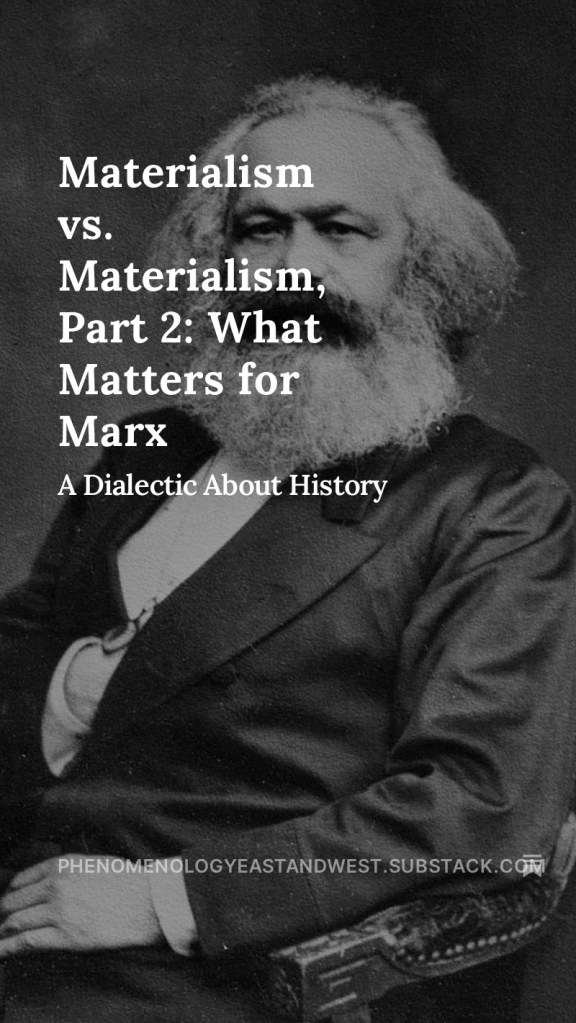
Materialism vs. Materialism, Part 2: What Matters for Marx

“Last week, we explored two major meanings of “materialism” that often get confused: ontological (or metaphysical) materialism, on the one hand, and methodological materialism, on the other. Today, we need to dig into a third use of the word: dialectical (and/or historical) materialism. So, what is that?

“Now, this is a question that often makes writers rather too wordy, so I am aiming to offer a tight summary. That means I will leave a lot out, but I think my presentation will be accurate, even if not perfectly precise. I also want to be clear that my academic background is not in Marxist theory, in particular, or even political economy, in general2 My engagement with Marx and Marxist and Marxian thought here will then be general and summary in form. I am sure that any more focused scholar of Marxism will have plenty of critiques of my outline below. My goal here is accuracy, but not always precision. That said, of course, (polite!) critiques in the comments are always welcome.

“The “dialectical” part of dialectical materialism is derived from the work of G.W.F. Hegel, whose (famously complex, opaque, and torturous) philosophy argued, in part, that history was the dialectical unfolding of a truth that is as of yet held only in potentiality rather than in actuality. What this means, for Hegel, is that history began with a set of primitive states, and that, over time, those states come into conflict (thesis and antithesis). Those conflicts do not result, though, in the victory of one over the other; instead, through the conflict, some new state is generated, that generally contains at least some of both of the previous two states (synthesis). So if, for example, there was some conflict between shamans and chiefs in our deep past, the resolution in history would not be the victory either of the religious leaders or the political leaders, but rather some new state of affairs that “sublated” both of them into a more complex and functional system: perhaps, for example, a new class of priest-kings who arrogated to themselves both spiritual and political leadership.

Continue reading at substack: https://phenomenologyeastandwest.substack.com/p/materialism-vs-materialism-part-2

Materialism vs. Materialism, Part 1: Getting Ahold of the Matter

“means many different things in different contexts. One person might say that their friend is too “materialistic”, a Marxist might describe themselves as a dialectical “materialist”, and a physicist might describe themselves as subscribing to a materialist conception of the universe—meanwhile, another physicist might subscribe to a materialist methodology in their scientific work, but not subscribe to it otherwise. Each use of this word means something rather different in each case. And it seems to me that often, even well-educated people confuse two (or more) of these meanings, often rendering conversations in science, philosophy, and politics much more opaque than they need be. Today, I’d like to do something about that.

“I’ve outlined four different meanings to materialist above; we can dispense with the first one pretty quickly. In everyday English, when we describe a person as materialistic, we are describing their personality, goals, and values, and are often also making a moral judgment about them. In this usage, being materialistic means that someone values material goods very highly (and normally, it is implied, too highly). So, if someone likes Lamborghinis, caviar, and multi-acre mansions, we would likely describe them as materialistic—and we might go further, and suggest that such things are not actually worth our time, attention, and effort (though, of course, there will be disagreement on that latter judgment). Certainly, some people know they are materialistic, and don’t see that as a problem at all:

Continue reading on Substack: https://phenomenologyeastandwest.substack.com/p/materialism-vs-materialism-part-1

Consciousness is not a Phenomenon, Part 2: Other People’s Windows

Last week, we saw that phenomenal consciousness, which is the “stage” upon which the world reveals itself to us as phenomena, is itself not a phenomenon, which makes any account of it—especially in material(ist) terms—exceedingly difficult. But to see just how serious the issue is, we need to move from a consideration of our own consciousness to how we might learn about the phenomenality of other people.

Red things just appear red to me, of course. But let’s say that we set up a little experiment. We find a hallway with a 90° turn. I sit at the corner itself and look down one leg of the hallway. I put a paint swatch at the other end of the hall, but I don’t tell you what color it is. You sit in the other leg of the hallway and look at me. I stare at the paint swatch, focusing on its color (spoiler warning: it’s green).

But what do you see? You see my head, and you see me staring intently. Within my brain, complex neurological activity is happening, which involves information processing that allows my brain-body complex to recognize the color green (understood as a specific hertz value of the electromagnetic radiation that struck my retina). This involves my eyes, the optic nerves, and probably many different sections of my brain. This is complicated, but not fundamentally mysterious. We can describe the process, beginning with the light bouncing off the swatch and ending with a brain state of “seeing green”, and we can describe it in purely mathematical terms. Meanwhile, also, this same process (somehow) results in my consciousness hosting the appearance of the quality of greenness (among many other things).

But where does the quality of greenness occur? Let’s say we isolate the part of my brain that actually process visual information and does the green-seeing. If we were able to install a little transparent window on the side of my head, would we expect to see that part of my brain glowing green?

Continue reading at: https://open.substack.com/pub/phenomenologyeastandwest/p/consciousness-is-not-a-phenomenon-f8a

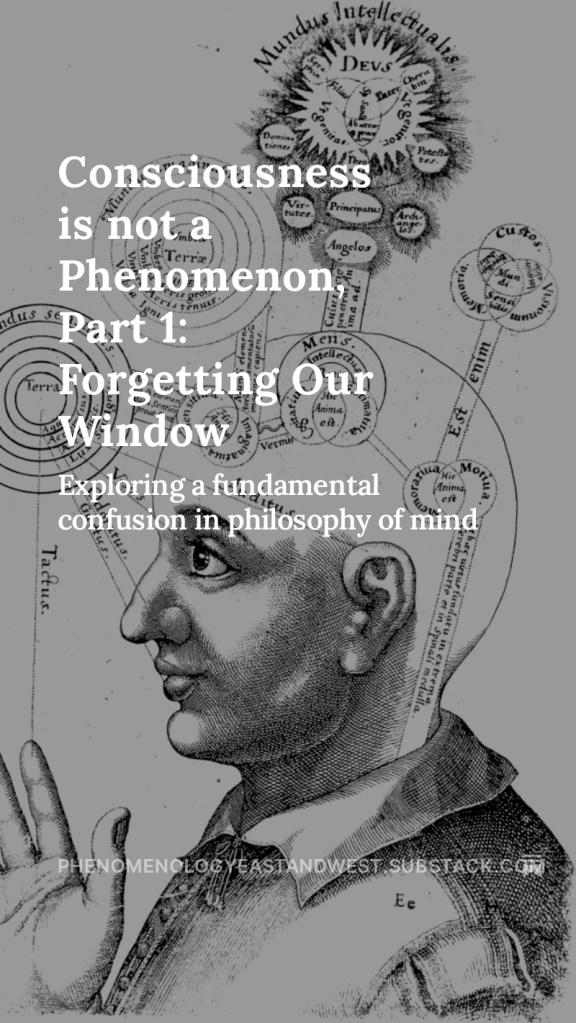
Consciousness is not a Phenomenon, Part 1: Forgetting Our Window

The question of what consciousness is has long interested—and perplexed—philosophers. Plato’s dialogue in the Phaedo, for example, is (in part) an effort to work out what consciousness might be. But the quest for an understanding of consciousness intensified in the latter part of the 20th century, at least within English-language philosophy. Contemporary Philosophy of mind developed in order to make sense of consciousness, to explain how consciousness could be fitted into the materialist ontology which had, by that time, become unquestionably dominant within most of academic philosophy.

However, after many decades of earnest work, the effort to arrive at a decisive answer to the question of how consciousness might arise from the brain seems no closer to success today than it did in 1950; indeed, in many ways, the pendulum seems to have shifted. More and more philosophers seem dubious that any materialist explanation of consciousness will be forthcoming.1

Now, there is much to say about all of this, both in making sense of the materialist strategies in philosophy of mind (eliminativism, epiphenomenalism, and “constitutivism”) as well as in the premises, assumptions, and biases that informed those efforts, and the fact that non-materialist or semi-materialist efforts to develop a philosophy of mind have not necessarily been any more successful (at least, so far). Philosophy of mind is an extremely complex and confusing group of discourses. I intend to write about it plenty in this space, but I will have to make sure I only bite off as much as I can chew each week.

So today I want to offer a general remark about a fundamental confusion that I see in much of philosophy of mind discourse—materialist or otherwise. It’s a confusion that I think helps to explain why so much of the writing on this subject is so often so fruitless and opaque.

Continue reading at: https://open.substack.com/pub/phenomenologyeastandwest/p/consciousness-is-not-a-phenomenon

“Be a Leader!”

I drop my two-year old off for daycare most weekday mornings. I normally say goodbye with some more-or-less stock phrase, like “have fun, buddy!” I can hear other parents nearby saying other similarly expected things, like “I love you!” or “Don’t worry, I’ll see you in a few hours.” Solid, classic, timeworn parenting phrases.1 But some parents like to offer more bespoke parting words, phrases less common, and, therefore, more memorable. One parent in particular often leaves her 2- or 3-year old son with these words: “be a leader!”

This farewell phrase immediately caught me off guard—and piqued my interest—for a number of reasons. The first thing that I wondered was what this phrase could possibly mean to such a young child. Can a three-year old be a leader? What does that look like? Who are they leading, and where? Surely we’d prefer the teachers to do the leading, at least at that age?

Which leaves open the question, though: even if “be a leader!” is not the right parting phrase to leave for a three-year old, still, some might think this parent has the right idea, just a bit too early: perhaps this would be a good thing to say when dropping off a second grader, or a fifth grader, or an eighth grader? But I’m not so sure. Indeed, I’m not sure this phrase would be a good thing to say to one’s child, even if they were heading momentarily over to the National Mall to be inaugurated as the next President of the United States.

Continue reading on substack at: https://open.substack.com/pub/phenomenologyeastandwest/p/be-a-leader

Postmodernism vs. Postmodernism, Part 2: Ontic vs. Epistemic Postmodernism

Last week, we took a look at the basic origin of postmodern philosophy, exploring how Kant’s distinction between the phenomenal and the noumenal set the stage for a crisis in modernist (i.e. more or less Enlightenment-era and, sometimes, post-Enlightenment) philosophy. I suggested at the end of that piece that the main reaction to this crisis—what we generally call postmodernism—took two distinct paths, one of which is the better-known (and frequently attacked), the other of which gets much less attention (but I think should get much more). So let’s dive right in1 (though if you haven’t read Part 1 and you aren’t that familiar with Kant’s work, you may want to read that first).

Western philosophers in the 19th century, who took Kant’s distinction seriously, were indeed in an intellectual crisis, for if the phenomena of our thinking lives—sensory impressions, concepts, the reasoning that binds them, etc.—have no guaranteed access to the noumena of reality, of things as they are in themselves, then it would be easy to give into despair: perhaps our thinking makes no contact with reality. If Kant is right, we can’t actually ever check or verify whether it does, since any new evidence we could evaluate would be, of course, evidence that we gathered with our senses and used our reason to organize into concepts—all evidence of the noumenal must become phenomenal for us to consider it at all.

From one perspective, then, post-Kantian philosophy found itself “locked in” to the mind. They wanted to say true things about reality, but had lost confidence that they could do so. What does an aspiring philosopher do in such dire straits?

Continue reading on my substack at: https://phenomenologyeastandwest.substack.com/p/postmodernism-vs-postmodernism-part-c1c

Postmodernism vs. Postmodernism, Part 1: The Birth of Postmodernism

“Postmodern” is one of those words we often hear, but which rarely gets defined. This is already a suspicious state of affairs, but when we add the fact that it’s almost always used as a pejorative or accusation which is hurled at one’s ideological enemies, our suspicion should intensify. If we are going to go around trying to disparage each other with 10-dollar words, we ought at least to know what they mean.

Right off the bat, though, let’s set some limits. The first thing to know is that “postmodernism” is used to refer to a range of different human activities: there is postmodern architecture, postmodern painting, postmodern literature, and postmodern philosophy—and I am sure there are plenty of other fields which host postmodern content, as well. Although there are some threads that connect these different kinds of postmodern activity, they are also very diverse: someone could like postmodern architecture, for example, but not like postmodern painting.

This is a substack about philosophy (and also other things, but none of those things are architecture or art), so I doubt it’ll surprise you hear that I won’t be addressing any kind of postmodernism except postmodern philosophy.1 So what is postmodern philosophy?

Continue reading at my substack: https://open.substack.com/pub/phenomenologyeastandwest/p/postmodernism-vs-postmodernism-part