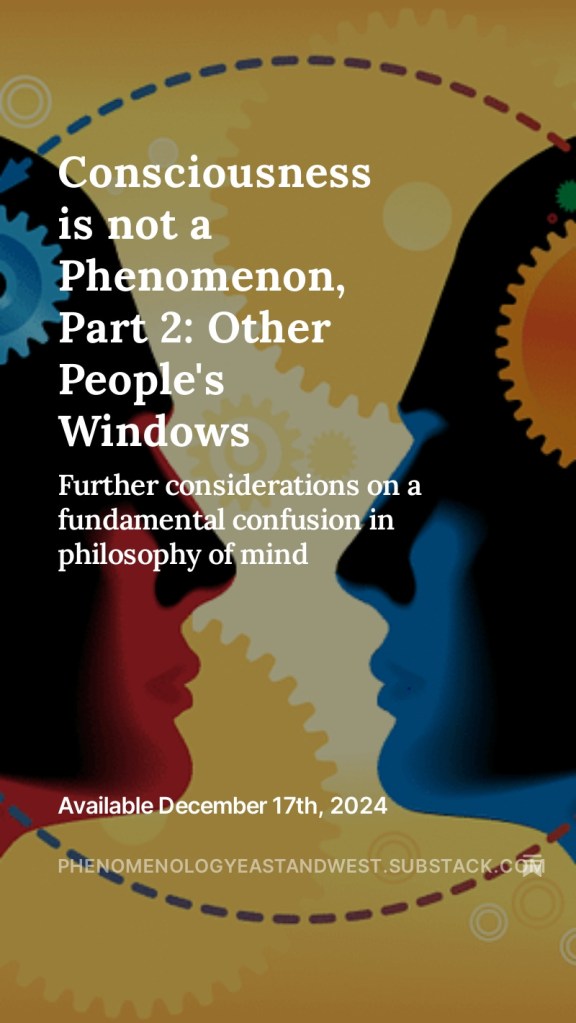
Consciousness is not a Phenomenon, Part 2: Other People’s Windows

Last week, we saw that phenomenal consciousness, which is the “stage” upon which the world reveals itself to us as phenomena, is itself not a phenomenon, which makes any account of it—especially in material(ist) terms—exceedingly difficult. But to see just how serious the issue is, we need to move from a consideration of our own consciousness to how we might learn about the phenomenality of other people.

Red things just appear red to me, of course. But let’s say that we set up a little experiment. We find a hallway with a 90° turn. I sit at the corner itself and look down one leg of the hallway. I put a paint swatch at the other end of the hall, but I don’t tell you what color it is. You sit in the other leg of the hallway and look at me. I stare at the paint swatch, focusing on its color (spoiler warning: it’s green).

But what do you see? You see my head, and you see me staring intently. Within my brain, complex neurological activity is happening, which involves information processing that allows my brain-body complex to recognize the color green (understood as a specific hertz value of the electromagnetic radiation that struck my retina). This involves my eyes, the optic nerves, and probably many different sections of my brain. This is complicated, but not fundamentally mysterious. We can describe the process, beginning with the light bouncing off the swatch and ending with a brain state of “seeing green”, and we can describe it in purely mathematical terms. Meanwhile, also, this same process (somehow) results in my consciousness hosting the appearance of the quality of greenness (among many other things).

But where does the quality of greenness occur? Let’s say we isolate the part of my brain that actually process visual information and does the green-seeing. If we were able to install a little transparent window on the side of my head, would we expect to see that part of my brain glowing green?
Continue reading at: https://open.substack.com/pub/phenomenologyeastandwest/p/consciousness-is-not-a-phenomenon-f8a
Postmodernism vs. Postmodernism, Part 2: Ontic vs. Epistemic Postmodernism

Last week, we took a look at the basic origin of postmodern philosophy, exploring how Kant’s distinction between the phenomenal and the noumenal set the stage for a crisis in modernist (i.e. more or less Enlightenment-era and, sometimes, post-Enlightenment) philosophy. I suggested at the end of that piece that the main reaction to this crisis—what we generally call postmodernism—took two distinct paths, one of which is the better-known (and frequently attacked), the other of which gets much less attention (but I think should get much more). So let’s dive right in1 (though if you haven’t read Part 1 and you aren’t that familiar with Kant’s work, you may want to read that first).

Western philosophers in the 19th century, who took Kant’s distinction seriously, were indeed in an intellectual crisis, for if the phenomena of our thinking lives—sensory impressions, concepts, the reasoning that binds them, etc.—have no guaranteed access to the noumena of reality, of things as they are in themselves, then it would be easy to give into despair: perhaps our thinking makes no contact with reality. If Kant is right, we can’t actually ever check or verify whether it does, since any new evidence we could evaluate would be, of course, evidence that we gathered with our senses and used our reason to organize into concepts—all evidence of the noumenal must become phenomenal for us to consider it at all.

From one perspective, then, post-Kantian philosophy found itself “locked in” to the mind. They wanted to say true things about reality, but had lost confidence that they could do so. What does an aspiring philosopher do in such dire straits?

Continue reading on my substack at: https://phenomenologyeastandwest.substack.com/p/postmodernism-vs-postmodernism-part-c1c

Phenomenology, East & West

Featured

I have been writing here at Wrestling with the Angel for about 10 years, often only intermittently. It’s changed names and focuses a few times. In the last year, my own interest has moved more and more towards a discussion of some particular topics, most notably phenomenology (broadly conceived) and related discipline like Vedanta and Neoplatonism.

So, I have started a Substack, Phenomenology, East & West. I will be posting there weekly. I will be linking those posts here as well (for a while), so if you are curious about that work, you can still check back here, and/or subscribe the Substack directly. I will likely also post some things only on this blog, especially if I want to write on something not really related to phenomenology itself.

(Note: I included links to the first few months’ worth of articles on the Substack here on my WordPress blog. I have since stopped doing so, since I figure anyone who wanted to follow me over there has done so. Rest assured, I have continued publishing over there. You can find all of those articles on my main substack page: https://phenomenologyeastandwest.substack.com/)

Without further ado, here’s the first, introductory post: Keeping Up Appearances: The Why, How, and Already of Phenomenology

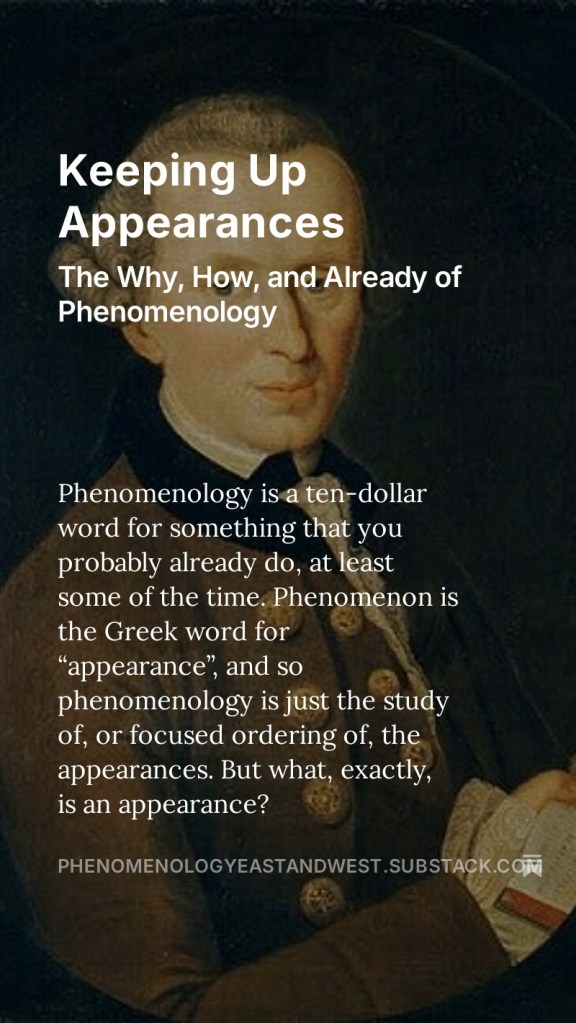
Phenomenology is a ten-dollar word for something that you probably already do, at least some of the time. Phenomenon is the Greek word for “appearance”, and so phenomenology is just the study of, or focused ordering of, the appearances. But what, exactly, is an appearance?

The use of this word in its more-or-less post/modern philosophical sense can be traced back to Immanuel Kant, in at least two ways. For one thing, the word “phenomenology” seems to have first appeared in a letter written to Kant. Second, and more importantly, the basic frame of phenomenology was set by Kant himself in his (in)famous Critique of Pure Reason.

In the Critique, Kant introduces a fundamental metaphysical distinction between the appearances (phenomena) and things-themselves (noumena). Kant was pointing out something that is, for most people, pretty obvious, but which we often ignore and which has massive philosophical consequences: the way things appear to us is not the same as the way things actually are, in and of themselves.

Click here to continue reading on Substack.