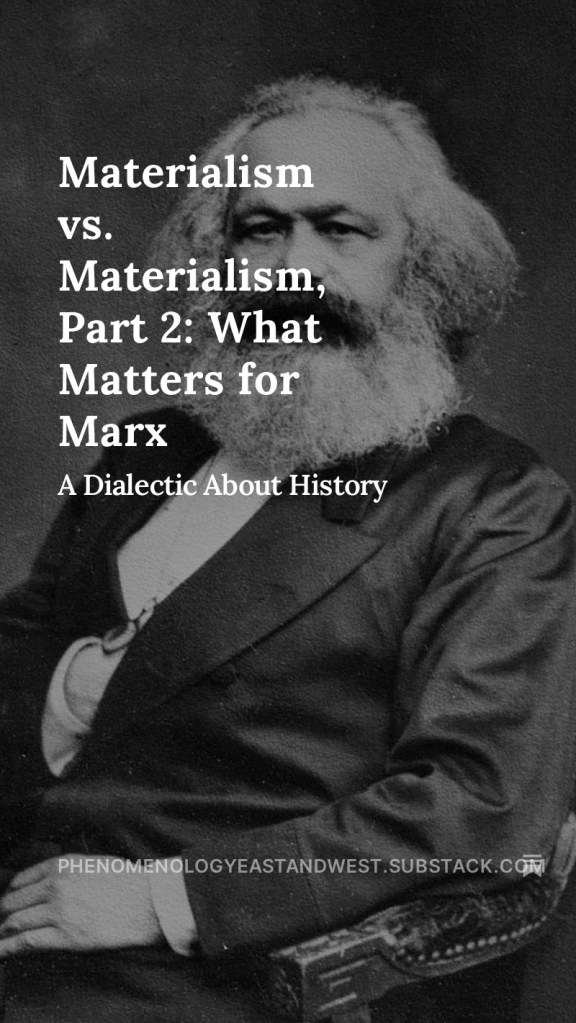
“Last week, we explored two major meanings of “materialism” that often get confused: ontological (or metaphysical) materialism, on the one hand, and methodological materialism, on the other. Today, we need to dig into a third use of the word: dialectical (and/or historical) materialism. So, what is that?
“Now, this is a question that often makes writers rather too wordy, so I am aiming to offer a tight summary. That means I will leave a lot out, but I think my presentation will be accurate, even if not perfectly precise. I also want to be clear that my academic background is not in Marxist theory, in particular, or even political economy, in general2 My engagement with Marx and Marxist and Marxian thought here will then be general and summary in form. I am sure that any more focused scholar of Marxism will have plenty of critiques of my outline below. My goal here is accuracy, but not always precision. That said, of course, (polite!) critiques in the comments are always welcome.
“The “dialectical” part of dialectical materialism is derived from the work of G.W.F. Hegel, whose (famously complex, opaque, and torturous) philosophy argued, in part, that history was the dialectical unfolding of a truth that is as of yet held only in potentiality rather than in actuality. What this means, for Hegel, is that history began with a set of primitive states, and that, over time, those states come into conflict (thesis and antithesis). Those conflicts do not result, though, in the victory of one over the other; instead, through the conflict, some new state is generated, that generally contains at least some of both of the previous two states (synthesis). So if, for example, there was some conflict between shamans and chiefs in our deep past, the resolution in history would not be the victory either of the religious leaders or the political leaders, but rather some new state of affairs that “sublated” both of them into a more complex and functional system: perhaps, for example, a new class of priest-kings who arrogated to themselves both spiritual and political leadership.
Continue reading at substack: https://phenomenologyeastandwest.substack.com/p/materialism-vs-materialism-part-2
 Wrestling with the Angel